On this page
Most people searching for BrowserStack alternatives do not want to replace BrowserStack. They want to know why the bill is high, why the end-to-end suite is slow and flaky, or whether a newer tool can say what actually broke. Only one of those is solved by another device cloud.
If the problem is the last one, checking what agent-written changes did inside your app, you can Start a 14-day trial (sign in, then add a card under Billing; the free plan needs none) or read the open-source SDK first.
BrowserStack is where your test harness sends its scripts to run on real browsers and devices. For that coverage it is the right tool, and nothing here that is not a device cloud competes with it. Like most cross browser testing tools, it checks what your scripts assert.
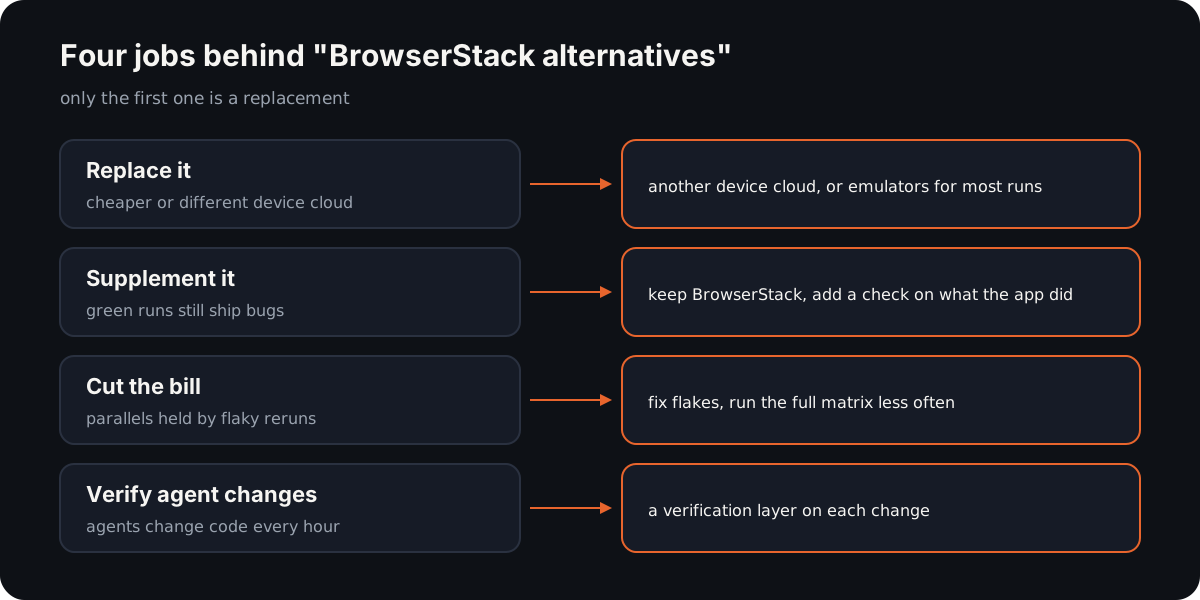
The four jobs behind "BrowserStack alternatives"
1. Replace it. You want the same thing, a device cloud, at a different price or with different devices. The BrowserStack competitors that do that job are other device clouds, covered in the comparison table.
2. Supplement it. The suite runs green on 30 browsers and bugs still ship: a double charge, a cart that never saved. A different cloud will not change that, because every cloud runs the same assertions. See what each verdict source can conclude.
3. Cut the bill. The cost is real, but much of it comes from how the cloud is used: every commit through the full matrix, retries holding parallels. See why teams leave before you migrate.
4. Verify agent-written changes. A coding agent changes the app many times a day, and each change needs a check on what it did, not on how it looks in Safari. That is a different tool, and it runs next to BrowserStack. See where Reticle fits.
Why teams leave BrowserStack
Cost at scale. BrowserStack pricing is per parallel test. On the pricing page on 2026-10-31, Automate Desktop was "$ 99 / month (billed annually)" and Desktop & Mobile "$ 175", each for one parallel. A team that wants ten tests at once pays for ten. One Hacker News commenter put it bluntly: managed solutions "like BrowserStack" cost "hundreds of dollars" (csomar).
Parallels held by flaky runs. A flaky test that retries keeps a parallel busy, and queued tests wait. BrowserStack's queue docs say a queued test is dropped after 15 minutes. One team "stopped due to flakiness" and got stable by testing against a local server and a mocked API (beingflo).
The fix is usually upstream of the vendor. BrowserStack's own Test Reporting & Analytics says it can "detect flaky, always-failing tests". Fixing those frees parallels on any cloud.
Speed. A remote browser adds network hops to every command. "They are expensive and slow" is a five-year-old complaint (o_m); the usual answer is local browsers for most commits.
Device-specific configs. Each browser, OS and device is a capabilities block someone maintains. That cost moves with you to any device cloud.
A green run does not say what the program did. BrowserStack's docs are honest about this: "BrowserStack cannot identify if your test's assertions have passed or failed" (docs). Your script tells it. The verdict is your assertion, run on many devices.
BrowserStack alternatives compared
Every cell comes from the tool's own docs or pricing page, checked on 2026-10-31. "Device matrix" means the verdict is still your assertion; the tool adds the real browsers and devices it runs on.
| Tool | Category | Verdict source | What it catches | What it misses | Price shape | Best fit |
|---|---|---|---|---|---|---|
| BrowserStack | Device cloud | Assertion, device matrix | Your assertions failing on a specific browser or real device | Anything your assertions do not check | Per parallel, per user for manual testing; Percy per screenshot | Teams that need real devices and many browsers |
| Sauce Labs | Device cloud | Assertion, device matrix | Your assertions failing on a browser, emulator or real device | Anything your assertions do not check | Per parallel | Teams comparing device clouds on price and coverage |
| Chromatic | Visual regression | Pixels | Visual changes in components and pages, across browsers on paid plans | Data and logic errors that render the same | Free tier, then per snapshot | Design-system and component teams |
| Reticle | Verification layer | App state, network, DOM | Silent failures: a double submit, a store that never updated, a console error | Cross-browser rendering, real devices, pixels | Open-source SDK and free plan; paid platform | Teams whose agents change a web app they own |
| Selenium IDE | Record-and-replay | Assertion | What you recorded and the asserts you added | Anything not asserted; nothing about devices | Free, open source | Quick recorded checks without writing code |
| QA Wolf | AI-generated suite (managed) | Assertion, reviewed by their agent | Failures in a suite they write and maintain | What the written tests do not cover | Per test run | Teams that want to buy coverage, not build it |
| Playwright (self-hosted) | Self-hosted runner | Assertion; pixels with screenshots | Your assertions in Chromium, Firefox and WebKit | Real devices: mobile is emulated | Free, open source | Teams that run most commits on their own CI |
Sauce Labs is the closest like-for-like BrowserStack alternative. Its pricing is per parallel, and your script sets the result with sauce:job-result=passed (docs). TestMu AI, "formerly LambdaTest", is a third device cloud.
Chromatic turns "existing Playwright end-to-end (E2E) tests into visual regression tests with a single import change" (docs). Its free plan tests on Chrome; Safari, Firefox and Edge start on Starter (pricing).
Selenium IDE is "open source record and playback test automation for the web" (Selenium). An assert text stops the test when it fails (commands).
QA Wolf writes and maintains "open source Playwright and Appium" tests and charges per run (QA Wolf, pricing). For AI suites you run yourself, see Momentic alternatives. Playwright runs on "Chromium, WebKit and Firefox" (docs); its mobile mode emulates "userAgent", "screenSize", "viewport" (emulation).
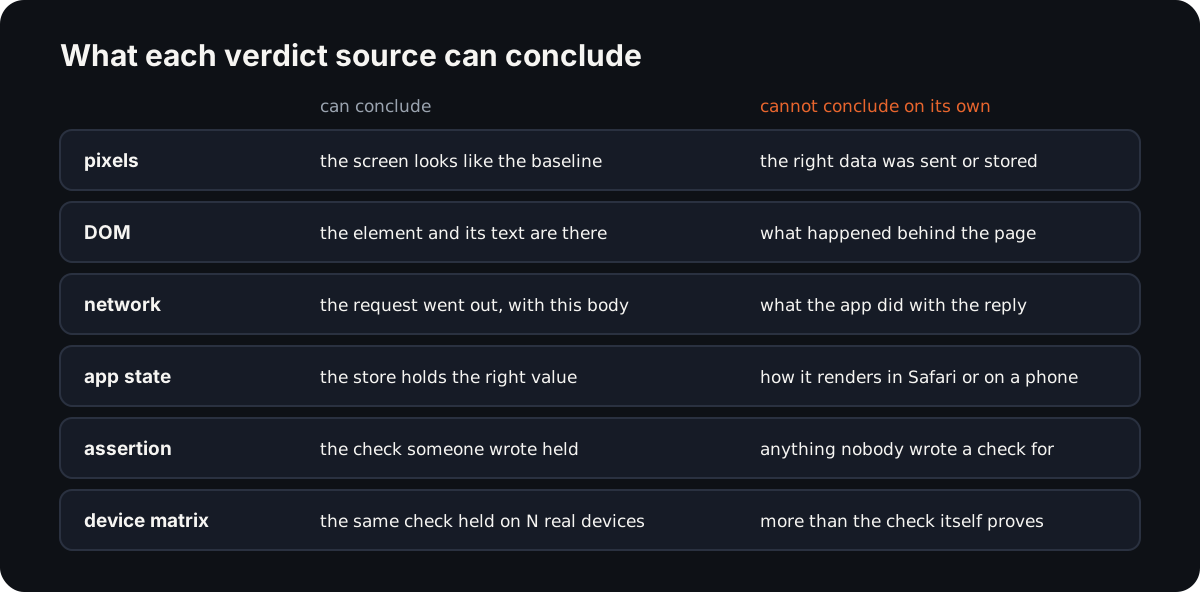
What each verdict source can conclude
Pixels conclude that the screen matches a baseline. They cannot tell whether the right data was sent or stored, because a wrong total in the right font looks fine.
DOM concludes that an element exists and holds some text. It cannot see what happened behind the page: the second charge request, the failed write that the UI never shows.
Network concludes that a request went out with a given body and got a given status. It cannot say what the app did with the reply.
App state concludes that the store holds the expected value after the action. It says nothing about how the page renders in Safari.
Assertion concludes that the check someone wrote held. It is as good as the check, and silent about everything nobody wrote down.
Device matrix multiplies an assertion across real browsers and devices. That is what catches the bug that only exists on iOS Safari. It never makes the assertion itself stronger.
Where Reticle fits, and where it does not
Reticle runs inside your web app as an SDK and decides pass or fail from network calls, app state and the console. A coding agent drives a flow once; saved flows then replay with no model.
Where it fits:
- Bugs a green run hides. On an 88-bug registry it caught 86, against 60 for a Playwright script driving the same flows (measured 2026-07-24, confidence table).
- Cheap re-checks for agent changes. A four-flow suite re-verifies in about 480 tokens, about 250x cheaper than an LLM re-drive, with 0% flake over eight replays (scorecard). A compiled suite costs no tokens at all.
Where it does not:
- Cross-browser rendering. A session runs in one browser. It does not compare Safari, Firefox and Chrome.
- A real device matrix. It has no device lab. BrowserStack says it has "30,000+ real iOS & Android devices"; Reticle has none.
- Visual diffing at scale. It reads structured events, not pixels. Chromatic or Percy is the right tool.
- Sites you do not own. It can drive a third-party page and read its DOM, network and console, but app state and the source line need the SDK in your build.
- Native mobile apps. It covers web and desktop apps, not native iOS or Android.
A team that needs browser and device coverage should keep BrowserStack. Reticle does not replace a device cloud.
Three tools beat Reticle on a stated axis. BrowserStack and Sauce Labs beat it on device and browser coverage, since Reticle has no device lab. Chromatic beats it on visual regressions, since Reticle never compares pixels. Playwright beats it on cost per re-run, because a compiled suite costs zero tokens.
Which BrowserStack alternative fits your team
| Team shape | Recommendation |
|---|---|
| Customers on many browsers and phones, suite works | Keep BrowserStack. Fix flaky tests first to free parallels. |
| Price or device list is the only problem | Sauce Labs or TestMu AI. Compare per-parallel prices for your matrix. |
| Bugs are visual: layout, spacing, theming | Chromatic on your components, beside the device cloud. |
| Most commits only need one browser | Playwright on your own CI per commit; BrowserStack nightly. |
| No one has time to write or maintain tests | QA Wolf, if per-run pricing fits the volume. |
| Agents change a web app you own many times a day | Run both: BrowserStack for the matrix, Reticle on each change. |
For runners rather than clouds, our Playwright alternatives page compares them by job. For the full set of regression testing tools, sorted by what decides pass or fail, see that comparison.
Migration effort
Moving to another device cloud. Your Selenium, Playwright, Cypress or Appium scripts transfer. What changes is the hub URL, the capabilities blocks, the code that reports pass or fail (browserstack_executor becomes sauce:job-result), and CI secrets. Our estimate, for a suite that already runs on one cloud: two to five engineer-days, most of it triaging tests that behave differently on the new devices.
Moving most runs to self-hosted Playwright. Playwright specs transfer as they are. Selenium specs are a rewrite: locators, waits and fixtures all change. Our Selenium alternatives page covers when that rewrite is worth it. Count about half a day per ten specs as a starting estimate, then measure your first twenty.
Adding Reticle beside BrowserStack. Nothing transfers, because nothing moves. RETICLE_INSTALL_SOURCE=blog npx @reticlehq/server init installs the SDK, and an agent records each flow by driving it once. Our estimate: half a day to install on one app, then under an hour per flow, including writing down what the flow should prove.
These are estimates from the steps involved, not measurements.
Fun fact
Cross-browser testing used to have a mascot. Acid2, released by the Web Standards Project in 2005, is a page that shows a smiley face only if the browser follows the standards, "with the nose turning blue when the mouse cursor hovers over it" (Wikipedia). Safari 2.0.2 passed first, on 31 October 2005, so the smiley turned 21 the day this page went up.
Conclusion
Pick between BrowserStack alternatives by the job. For a different device cloud, compare Sauce Labs and TestMu AI on your own matrix. For visual bugs, add Chromatic. For bugs that pass on every browser because nobody checked what the app did, keep BrowserStack and add a check inside the app.
FAQ
What is the best BrowserStack alternative?
The best BrowserStack alternative depends on the job. For another device cloud, Sauce Labs and TestMu AI are the closest; for visual regressions, Chromatic; for most commits on one browser, self-hosted Playwright. If green runs keep shipping bugs, no device cloud fixes that, so add a check on what the app did.
Is BrowserStack worth it?
BrowserStack is worth it when your users are spread across browsers and real devices and your tests run on them. It is less worth it for running every commit through the full matrix, or as a fix for flaky tests. Run most commits locally, the matrix less often, and fix flakes first.
Can you use BrowserStack with Playwright?
Yes, you can use BrowserStack with Playwright. BrowserStack Automate runs Playwright tests on its browsers and mobile devices, and your test reports pass or fail back to it. Many teams run Playwright on their own CI for each commit and send the same specs to BrowserStack for the wider matrix.
What replaces BrowserStack for mobile testing?
Another real-device cloud replaces BrowserStack for mobile testing: Sauce Labs, or AWS Device Farm, billed at $0.17 per device minute. Firebase Test Lab is deprecated and shuts down on 30 September 2027. For local runs, Appium and Maestro drive emulators and simulators, which catch most bugs before real devices.