
On this page
Searches for Selenium alternatives hide two different questions. Selenium WebDriver is a browser driver: it clicks, types and reads the page, "as a user would" (Selenium). Whether the outcome was right is decided by the test code around it.
So some searchers need a better driver and runner, and others need judgement about what the app did. Those are different purchases, and most pages that rank for an alternative to Selenium only answer the first.
If you need the second one, you can Start a 14-day trial (sign in, then add a card under Billing; the free plan needs none) or read the open-source SDK first.
Selenium sits at the bottom of most automated testing stacks, and for many teams it should stay there. People call it a Selenium testing tool, but its own docs file JUnit and NUnit under "Framework: An additional library that is used as a support for WebDriver suites" (components). That split is the whole page.
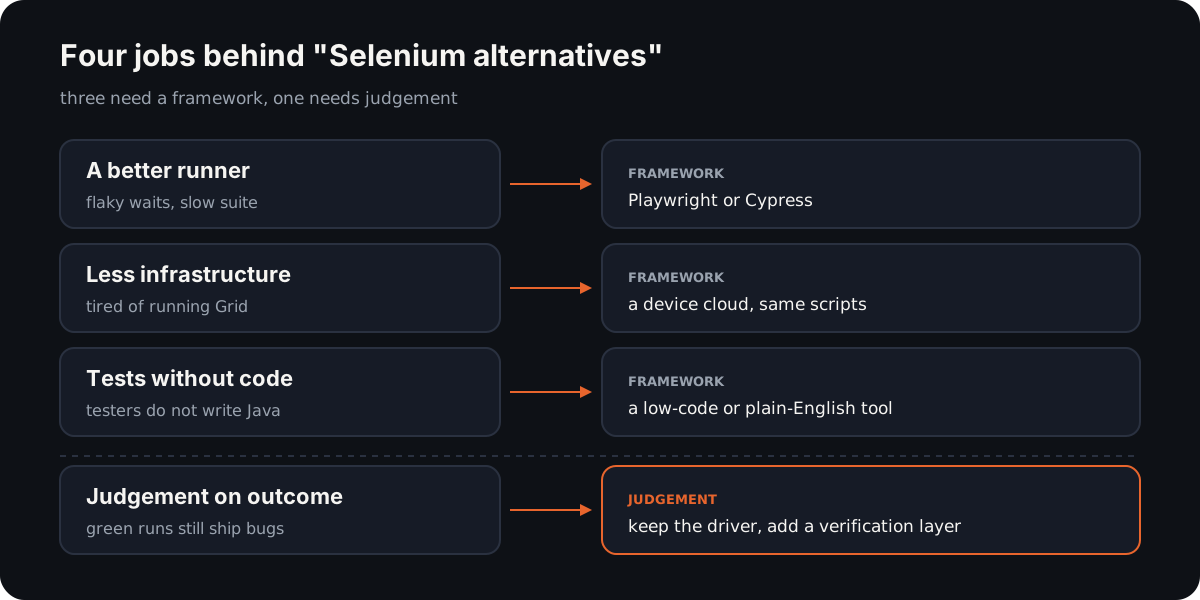
The four jobs behind "Selenium alternatives"
1. A better framework around the browser. Your suite is slow or flaky and you want auto-waiting, parallel runs and a trace when a test fails. That is a runner and driver swap: Playwright or Cypress. See the comparison table.
2. Judgement on the outcome. The suite is green and bugs still ship: a double charge, a save that never reached the server. A different driver will not fix that, because every driver reports only what your assertions check. See where Reticle fits.
3. Less infrastructure. You run Selenium Grid yourself and want someone else to own the browsers. A device cloud runs your existing Selenium scripts. See why teams leave.
4. Tests without code. The people who know the flows do not write Java. Low-code and plain-English tools exist for that, at a price. See the team-shape table.
Why teams leave Selenium
Waits and flakiness. Selenium's docs name the problem first: scripts "end up in a race condition where sometimes the browser gets into the right state first" (waits). The same page warns "Do not mix implicit and explicit waits", which "can cause unpredictable wait times".
A contractor who used it at seven companies wrote "Selenium is great. It really is. But the level of flaky tests that generally get produced is just so painful" (beatthatflight). The fix inside Selenium is explicit waits on conditions; Playwright builds them in, waiting "for all the relevant checks to pass" before acting (auto-waiting).
Grid maintenance. Grid runs suites "in parallel against multiple machines" (Grid). Grid 4 splits into a Router, Distributor, Session Map, New Session Queue, Event Bus and Nodes (components), and someone has to run them. A device cloud takes the same scripts and hands that job to a vendor.
Driver upkeep, mostly solved. A 2022 comment counted "15-20 minute time sink" each time the driver had to catch up with the browser (wickchuck). Selenium Manager now handles "automated driver and browser management" (docs), so check your version before you migrate for this.
No judgement built in. WebDriver reports what the browser did. Pass or fail is your assertion, and a failed step surfaces as an exception such as StaleElementReferenceException (errors). In a Java stack, that means reading a stack trace back to the step. Playwright's trace viewer replays the run instead.
Its lead has narrowed. Playwright Test "runs tests in parallel" by default (parallelism), and the W3C's WebDriver BiDi brings two-way events to Selenium itself. Raw speed is a weak reason on its own: waits "dwarf the differences in performance between libraries" (bdcravens).
Selenium alternatives compared
Each cell comes from the tool's docs or pricing page, checked on 2026-11-01. The verdict-source values are the ones defined on our BrowserStack alternatives page.
| Tool | Category | Verdict source | What it catches | What it misses | Price shape | Best fit |
|---|---|---|---|---|---|---|
| Selenium WebDriver | Browser driver | Assertion | Whatever your test framework asserts, in Chrome, Edge, Firefox and Safari | Anything nobody asserted | Free, open source | Teams with suites in Java, C#, Python or Ruby |
| Playwright | Driver and test runner | Assertion; pixels with screenshots | Your assertions in Chromium, Firefox and WebKit, retried until they pass | Anything nobody asserted | Free, open source | Teams starting fresh or rewriting a flaky suite |
| Cypress | In-browser test runner | Assertion | Your assertions in Chrome-family and Firefox, experimental WebKit | Multi-tab flows; non-JavaScript test code | Free app; Cloud free tier, then plans by test-result volume | Front-end teams writing JavaScript |
| Reticle | Verification layer | App state, network, DOM | Silent failures: a double submit, a store that never updated, a console error | Cross-browser rendering, real devices, pixels | Open-source SDK and free plan; paid platform | Teams whose agents change a web app they own |
| TestMu AI | Device cloud | Assertion, device matrix | Your Selenium assertions on many browsers and real devices | Anything your assertions do not check | Per parallel | Teams that want Grid run by someone else |
| Katalon | Low-code platform | Assertion | Recorded or low-code checks across web, mobile, API and desktop | What the recorded checks do not cover | Free tier, then per seat | QA teams with few programmers |
| testRigor | Plain-English, AI-assisted | DOM, pixels (OCR), AI judgement | Plain-English checks such as "check that page contains" | Anything not written as a check; AI checks can be wrong | Not public | Teams that want tests in English sentences |
Selenium speaks Java, Python, C#, Ruby, JavaScript and Kotlin (install). Playwright is available for Node.js, Python, Java and .NET (languages). Cypress says "The only language we'll ever support is the language of the web: JavaScript" (trade-offs).
TestMu AI lists per-parallel plans on its pricing page. Katalon has a free tier and Professional at "$1,800 / seat / year" billed annually on 2026-11-01 (pricing). testRigor warns that "AI can sometimes have hallucinations" in its AI checks (docs); its pricing page returned a 404 when we checked. For AI-driven platforms, see Momentic alternatives.
What each verdict source can conclude
The full breakdown is on the BrowserStack alternatives page. For Selenium the short version is this.
Assertion is all a driver gives you. Selenium, Playwright and Cypress differ in how they wait, retry and report, not in what a passing test proves. Moving between them changes the cost of a check, not its reach.
Device matrix multiplies that assertion across real browsers. It finds the Safari-only bug and proves nothing new on Chrome.
App state and network are the sources a driver never reads. A checkout that charges twice and renders once passes every assertion on the page. That gap is the second question from the opening, and it needs a different tool, not a better driver.
AI judgement reads the screen and decides whether a sentence is true. It can check things nobody wrote a selector for, and it can be wrong.
Where Reticle fits, and where it does not
Reticle runs inside your web app as an SDK and decides pass or fail from network calls, app state and the console. An agent drives a flow once; saved flows replay with no model.
Where it fits:
- Bugs a green run hides. On an 88-bug registry it caught 86, against 60 for a Playwright script driving the same flows (measured 2026-07-24, confidence table).
- Cheap re-checks for agent changes. A four-flow suite re-verifies in 483 tokens, 251x cheaper than an LLM re-drive, with 0% flake over eight replays (scorecard).
Where it does not:
- Cross-browser rendering. A session runs in one browser. Selenium drives Chrome, Edge, Firefox and Safari (browsers).
- A real device matrix. It has no device lab.
- Visual diffing. It reads structured events, not pixels.
- Source lines on Vue and Angular. It runs on React, Next.js, Vue, Svelte and Angular, but the
file:linepointer is for React and Svelte only. - Language breadth. There is no Java, C#, Ruby or Kotlin API. If your tests and your testers live in Java, Selenium is where that code belongs.
Three tools beat Reticle on a stated axis. Selenium beats it on language breadth and browser coverage, with six language bindings and four browsers. TestMu AI beats it on real devices, since Reticle has none. Playwright beats it on cost per re-run, because a compiled suite costs zero tokens.
Which Selenium alternative fits your team
| Team shape | Recommendation |
|---|---|
| Large Java or C# suite that mostly passes, Grid in place | Keep Selenium. Move to explicit waits and Selenium Manager first. |
| JavaScript or TypeScript team, suite flaky, rewrite on the table | Playwright. Auto-waiting and traces address the two common complaints. |
| Front-end team, Chrome and Firefox are enough | Cypress, if single-tab flows cover what you ship. |
| Tired of running Grid, scripts are fine | TestMu AI or another device cloud. Same scripts, someone else's browsers. |
| Testers who do not write code | Katalon or testRigor. Price it against a year of engineer time. |
| Agents change a web app you own many times a day | Keep Selenium and add a verification layer: Selenium for browsers, Reticle on each change. |
If you are choosing between modern runners, our Playwright alternatives page compares them by job.
Migration effort
Selenium to a modern framework. Well documented, moderate in cost. Test intent transfers; code does not: locators, waits, fixtures, runner config and Page Objects are rewritten in the new API. Our estimate: about half a day per ten specs once the first twenty are done, plus one to three days for CI and reporting. Measure your first twenty before you promise a date.
Selenium to a verification layer. Nothing is rewritten, because Selenium keeps running. RETICLE_INSTALL_SOURCE=blog npx @reticlehq/server init installs the SDK, and an agent records each flow by driving it once. Our estimate: half a day to install on one app, then under an hour per flow, including writing down what it should prove. The result is a different artefact: a recorded flow and a verdict, not a test file.
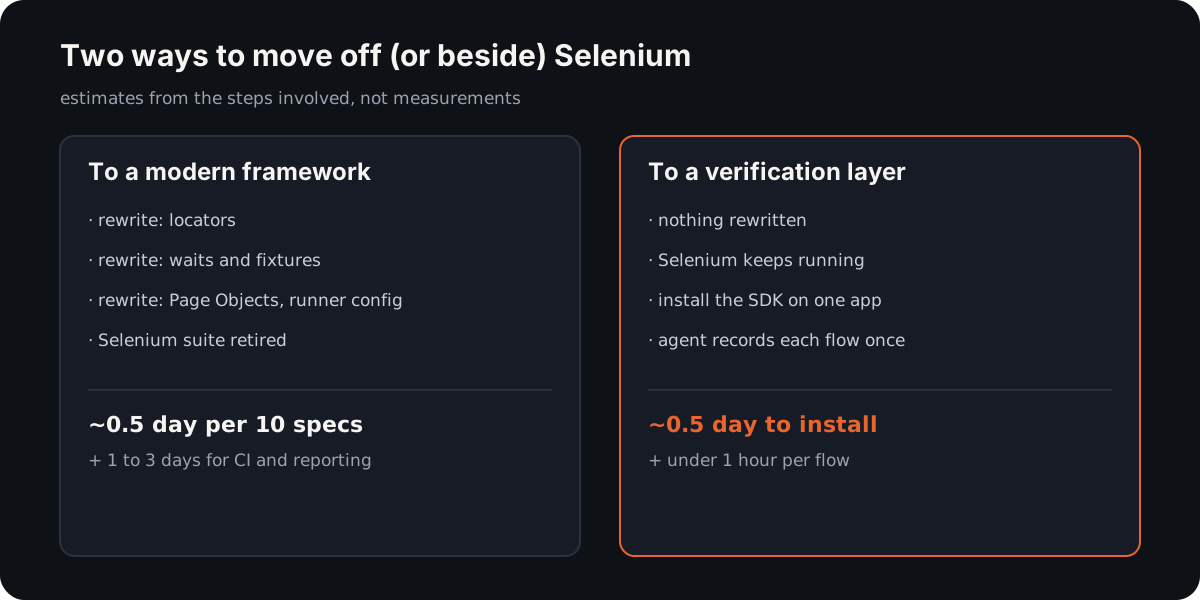
These are estimates from the steps involved, not measurements.
Fun fact
Selenium was named as an alternative. Jason Huggins built it at ThoughtWorks in 2004, and the name came from a joke in an email mocking a competitor called Mercury: mercury poisoning "can be cured by taking supplements of the element selenium" (Wikipedia). So this page lists alternatives to an alternative.
Conclusion
Decide which of the two questions you are asking. For a better driver and runner, Playwright and Cypress are the usual answer, and Selenium is still right for big suites in Java or C#. For judgement on what the app did, keep whichever driver you have and add a check that reads app state and network.
FAQ
What is the best Selenium alternative?
The best Selenium alternative depends on the job. For a faster, less flaky runner, Playwright is the most common choice; for JavaScript front-end teams, Cypress. To stop running Grid, use a device cloud with your existing scripts. If green runs still ship bugs, no driver fixes that, so add a verification layer.
Is Playwright better than Selenium?
Playwright is better than Selenium for new suites in JavaScript, Python, Java or .NET that want built-in auto-waiting, parallel runs and traces. Selenium is better when you need Ruby or Kotlin, an existing Grid, or a large working suite you would otherwise rewrite. In Selenium vs Playwright, both only report what your assertions check.
Is Selenium still used in 2026?
Yes, Selenium is still used in 2026. It is a W3C-standard browser driver with bindings for six languages, maintained alongside Grid and Selenium Manager, and device clouds run Selenium scripts. Many teams keep existing suites on it and write new ones in Playwright, which is a reasonable split rather than a failed migration.
Can you use Selenium and a verification layer together?
Yes, you can use Selenium and a verification layer together, and it is the cheapest change. Selenium keeps driving browsers and checking your assertions. The verification layer runs inside the app and checks what each change did to network calls and app state, which no driver reads. Nothing in the Selenium suite has to change.