
On this page
If you are searching for Momentic alternatives, you have probably tried Momentic or shortlisted it. The useful question is not which tool has more AI. It is what each one uses as its source of truth when it decides that a change worked.
Momentic AI leans on an agent built to understand "what the user actually meant" (Momentic blog) and to adapt when the page changes. Reticle records a path and replays it against program state. Each answer is right for a different team, and this page is a Momentic review on that one axis.
If you want a verdict from program state, you can Start a 14-day trial (sign in, then add a card under Billing; the free plan needs none) or read the open-source SDK first.
Both tools sit in the AI QA category, and both run in CI. They differ in what decides pass or fail, so that is how this page compares them.
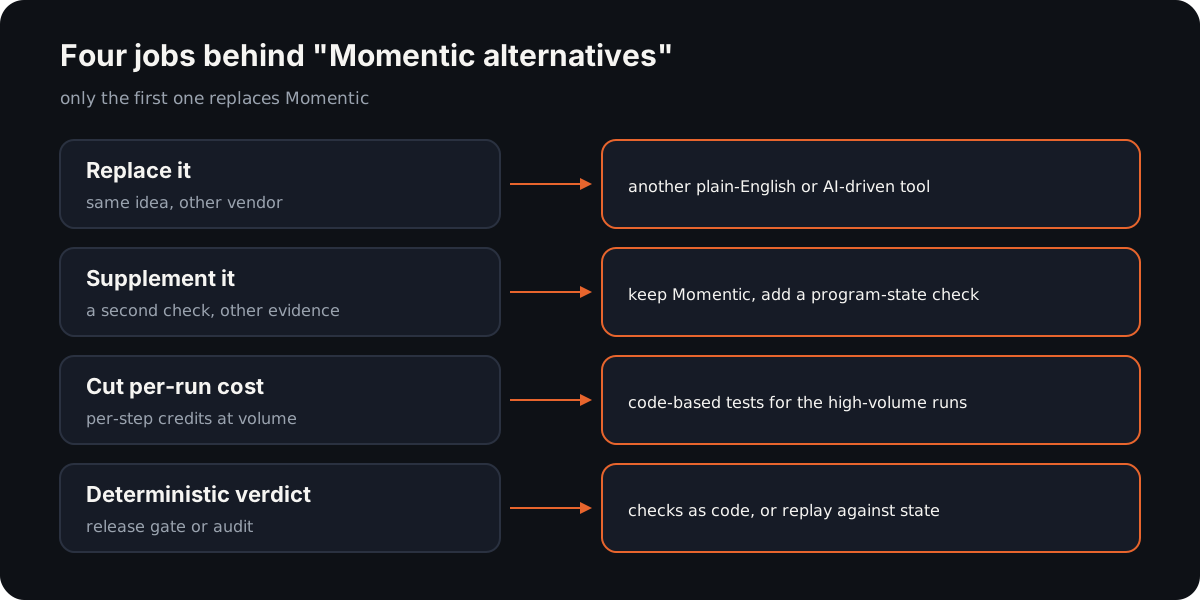
The four jobs behind "Momentic alternatives"
1. Replace it. You want plain-English tests and AI-driven steps from a different vendor, or self-hosted. The comparison table lists the tools that work that way.
2. Supplement it. Momentic covers your flows, and you want a second check that decides from different evidence. See where Reticle fits.
3. Cut per-run cost. Momentic pricing is in credits, one for a normal step, and a suite that runs on every commit adds up. See why teams look beyond Momentic.
4. Get a deterministic verdict. You need the same run on the same build to give the same answer, every time, for a release gate or an audit. That favours tools whose checks are code or recorded state, covered in what each verdict source can conclude.
Why teams look beyond Momentic
None of these is a defect. Each is a trade-off, and Momentic's own docs describe the first three.
Per-run cost at volume. On its pricing page on 2026-11-01, Pay-as-you-go was "$125 / month + additional usage" with 10,000 credits. "A normal test step costs 1 credit. A step generated by an AI action or failure recovery costs 2 credits." Extra credits cost "$0.01875 / credit". By that arithmetic, a ten-step run beyond the allowance costs about 19 cents before hosting: cheap per run, and it adds up for a suite that runs on every commit.
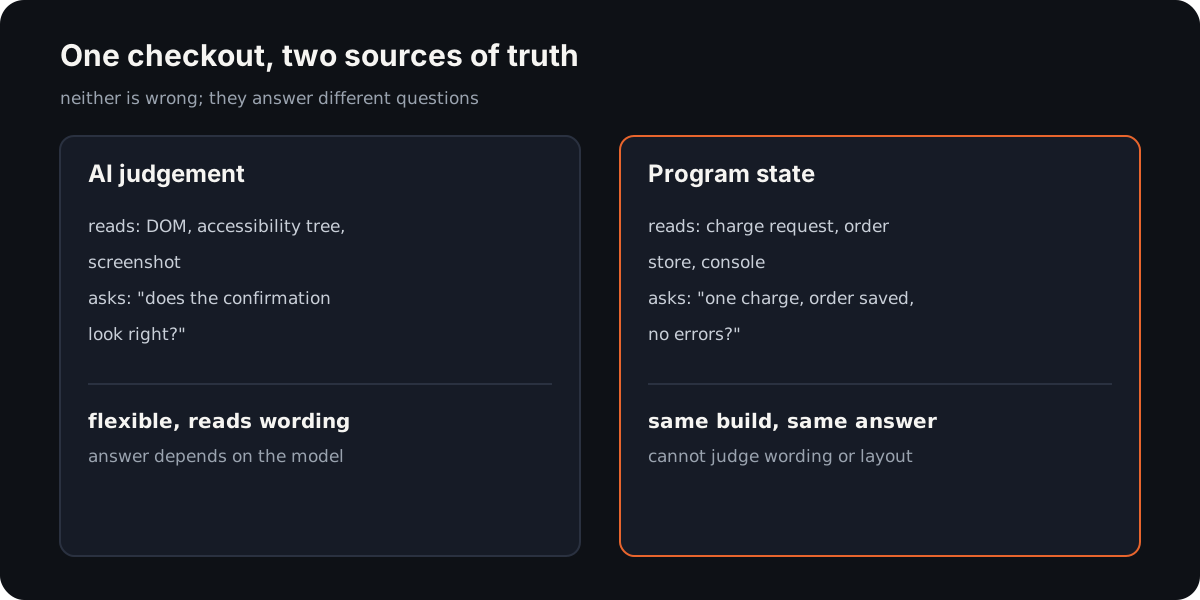
A verdict from an agent's judgement. Momentic's AI check "evaluates assertions against the DOM, accessibility tree, and a screenshot of the viewport" (docs). Its docs say "Agentic steps are flexible but non-deterministic; assertions check the result" (agentic testing).
Cached steps replay "without invoking the LLM", but AI checks are never cached (step cache). Momentic also has exact checks, such as asserting "that the page HTML contains a substring" (commands), so teams can choose.
Portability. Momentic tests are "YAML files in your repository" and "The format is published" (portability). The same page says "Momentic ships no exporter", that some steps "have no equivalent in an open-source framework", and that run history, AI memory and step caches "stay behind" if you leave.
An auditable, reproducible result. Some teams need to show why a release passed. Which model judged a given AI check, and whether two runs of the same check always agree, is not stated in the public docs we read on 2026-11-01.
Momentic alternatives compared
Each cell comes from the tool's own pages, checked on 2026-11-01. Verdict sources follow our BrowserStack alternatives page, plus AI judgement: a model reads the page and decides whether a stated check is true.
| Tool | Category | Verdict source | What it catches | What it misses | Price shape | Best fit |
|---|---|---|---|---|---|---|
| Momentic | AI-native test platform | AI judgement, DOM, pixels, network | Plain-English checks on the DOM, accessibility tree and screenshot; visual diffs; request checks | Firefox and Safari: web runs on Chromium-family browsers | Free tier, then per credit | Teams that want tests in plain English, web and native mobile |
| mabl | Low-code test platform | DOM, assertion; AI checks unclear | HTML and CSS assertions across web, mobile and API tests | Anything not asserted | Quote | QA teams buying a managed low-code platform |
| Reticle | Verification layer | App state, network, DOM | Silent failures: a double submit, a store that never updated, a console error | Native mobile, cross-browser rendering, pixels | Open-source SDK and free plan; paid platform | Teams whose agents change a web app they own |
| Functionize | AI-native test platform | Unclear | What its agents are told to check | Not publicly documented | Free tier, then monthly plans with credits | Teams that want agents to write and run tests |
| AWS Device Farm | Device cloud | Assertion, device matrix | Your tests on real mobile devices and desktop browsers | Anything your assertions do not check | Per device minute, or unmetered plans | Teams that need real phones |
| Playwright (self-hosted) | Driver and test runner | Assertion; pixels with screenshots | Your assertions in Chromium, Firefox and WebKit | Anything nobody asserted; native apps | Free, open source | Teams that want checks as code they own |
| Midscene.js | Open-source AI agent | AI judgement | Natural-language aiAssert checks on web, mobile and desktop | Whatever the model you configure misreads | Free, open source; model costs are yours | Teams that want plain-English steps, self-hosted |
Momentic runs iOS tests "on local or Momentic-hosted simulators" and Android on emulators (Momentic); its docs say "Physical devices are not supported" (iOS). Web runs on "a Chromium-family browser" (browsers).
mabl lists "Request a Quote" and says "local test runs are free" (pricing); its blog describes how to "assert on both HTML and CSS" (mabl). Its help centre refused our requests, so how its AI checks decide is marked unclear. Our mabl alternatives page compares it in depth.
Functionize says "A machine learning core verifies what your application does" (Functionize), without public detail on how, hence unclear. AWS Device Farm charges "$0.17 / device minute" (pricing). Midscene.js is a "vision-based GUI Agent", MIT-licensed (Midscene).
What each verdict source can conclude
The general breakdown is on the BrowserStack alternatives page. Two sources matter most here.
AI judgement concludes that a model, reading the page, found a sentence true. It can check things nobody wrote a selector for, such as "the confirmation mentions the order number". Its answer depends on the model and what it saw. Momentic's docs say the agent "tolerates minor typos", so john@@gmail.com matches john@gmail.com, and offer exact matching when that matters (docs).
App state concludes that the store, the request and the console hold what the flow should have produced. It cannot judge wording or layout. It gives the same answer for the same build every time.
Most teams want both kinds of answer for different flows. That is why "run both" is a real recommendation below.
Where Reticle fits, and where it does not
Reticle runs inside your web app as an SDK. An agent drives a flow once; saved flows replay with no model and decide from network calls, app state and the console.
Where it fits:
- Bugs a green run hides. On an 88-bug registry it caught 86, against 60 for a Playwright script driving the same flows (measured 2026-07-24, confidence table).
- Repeatable re-checks. A four-flow suite re-verifies in 483 tokens with 0% flake over eight replays (scorecard).
Where it does not:
- Mobile and native apps. Reticle covers web and desktop apps. Momentic tests native iOS and Android apps. A mobile-heavy team should choose Momentic.
- Tests from intent or plain English. Momentic lets you describe a flow and its expected result "in plain English" (Momentic). Reticle records what an agent did; it does not write tests from a description.
- Self-healing selectors. Momentic's locator agent "finds the element again from the step's description" when a cached target breaks (auto-maintenance). Reticle has no equivalent.
- Team workflow features. Momentic's pricing page lists failure classification, quarantine rules, AI test selection, email inboxes and SMS numbers for one-time codes. Reticle ships none of these.
- Visual diffs and cross-browser rendering. Momentic diffs against golden files (docs). Reticle reads events, not pixels.
Three tools beat Reticle on a stated axis. Momentic beats it on native mobile apps, plain-English authoring and self-healing locators. AWS Device Farm beats it on real devices, which Reticle does not have. Playwright beats it on browser engines and cost per re-run, since a compiled suite costs zero tokens.
Which Momentic alternative fits your team
| Team shape | Recommendation |
|---|---|
| Mobile-heavy: native iOS and Android apps | Momentic. It tests native apps on simulators and emulators; Reticle does not test native apps. |
| Testers write flows in plain English, Chromium is enough | Keep Momentic. Watch credit use as run volume grows. |
| Procurement wants a managed low-code platform | mabl. Ask for a quote against your run volume. |
| Release needs real phones, not simulators | AWS Device Farm or another device cloud, beside whatever writes the tests. |
| Wants deterministic checks as code, no per-run fee | Playwright self-hosted; Midscene.js if you want AI steps you host. |
| Agents change a web app many times a day, mobile too | Run both: Momentic for mobile and plain-English coverage, Reticle on each web change. |
If you are weighing code-first runners, our Playwright alternatives page compares them by job, and the Selenium alternatives page covers moving off an older driver.
Migration effort
From Momentic to Playwright. The YAML tests are in your repo, so the intent transfers. Code does not: "Momentic ships no exporter", and a port "must express each of these as explicit code, or drop it", referring to the AI steps (portability). Enterprise customers can ask for "a one-time eject to open-source Playwright" at contract end.
Our estimate: half a day per ten tests for plain steps, more where AI checks need a written assertion. Run history and AI memory do not move.
To Momentic from Playwright. Momentic "ships no automatic converter" and recommends porting one bounded flow at a time with its coding-agent skill (same page). Re-authoring is the cost.
Adding Reticle beside Momentic. Nothing moves. RETICLE_INSTALL_SOURCE=blog npx @reticlehq/server init installs the SDK, and an agent records each web flow by driving it once. Our estimate: half a day to install, then under an hour per flow.
These are estimates from the steps involved, not measurements.
Fun fact
The most famous bug report in computing came with physical evidence. In 1947, operators traced a Mark II error to a moth in a relay and taped it into the log book with the note "First actual case of bug being found" (Wikipedia). The word "actual" is the joke: engineers had called faults bugs since at least the 1870s.
Conclusion
Choose between Momentic alternatives by the source of truth you need. For native mobile apps and tests written in plain English, Momentic is the stronger choice. For checks as code with no per-run fee, Playwright. For a repeatable verdict on what a web change did, add a check against program state, and keep Momentic where it already works.
FAQ
What are the best Momentic alternatives?
The best Momentic alternatives depend on the job. For a managed low-code platform, mabl or Functionize; for real devices, AWS Device Farm; for checks as code, self-hosted Playwright; for open-source AI steps, Midscene.js. For a repeatable verdict on web changes, add a verification layer that replays against program state.
Is Momentic reliable?
Momentic documents its reliability trade-offs plainly. Cached steps replay without calling a model, locators heal when the page changes, and AI checks are never cached, so they are judged fresh each run. Its docs describe agentic steps as flexible but non-deterministic, with assertions checking the result. Test your own flows before committing.
Momentic vs Playwright: which should I use?
In Momentic vs Playwright, Momentic suits teams who want plain-English tests, AI steps, self-healing locators and native mobile on simulators. Playwright suits teams who want checks as code, three browser engines and no per-step fee. Momentic tests can be ported to Playwright, but AI steps must be rewritten as explicit code.
Can you use Momentic and Reticle together?
Yes, you can use Momentic and Reticle together. Momentic covers mobile apps and plain-English flows with AI checks. Reticle runs inside your web app and checks what each change did to requests, state and the console, replayed with no model. Neither tool has to change for the other to run.