
On this page
Most people searching for mabl alternatives are not unhappy with mabl. They are working out whether they need a platform at all.
mabl sells one: authoring, execution, maintenance and governance for a QA organisation, with the audit trail an enterprise asks for. Some teams need exactly that. Others need one check that runs after every edit, cheaply and the same way each time.
If the second sounds like your team, you can Start a 14-day trial (sign in, then add a card under Billing; the free plan needs none) or read the open-source SDK first.
Both are forms of AI test automation, and both now talk about verifying code and delivering evidence. mabl's own navigation uses "Verify your code" and "Deliver evidence". So this page compares what each tool does after a change, not what each one calls it.
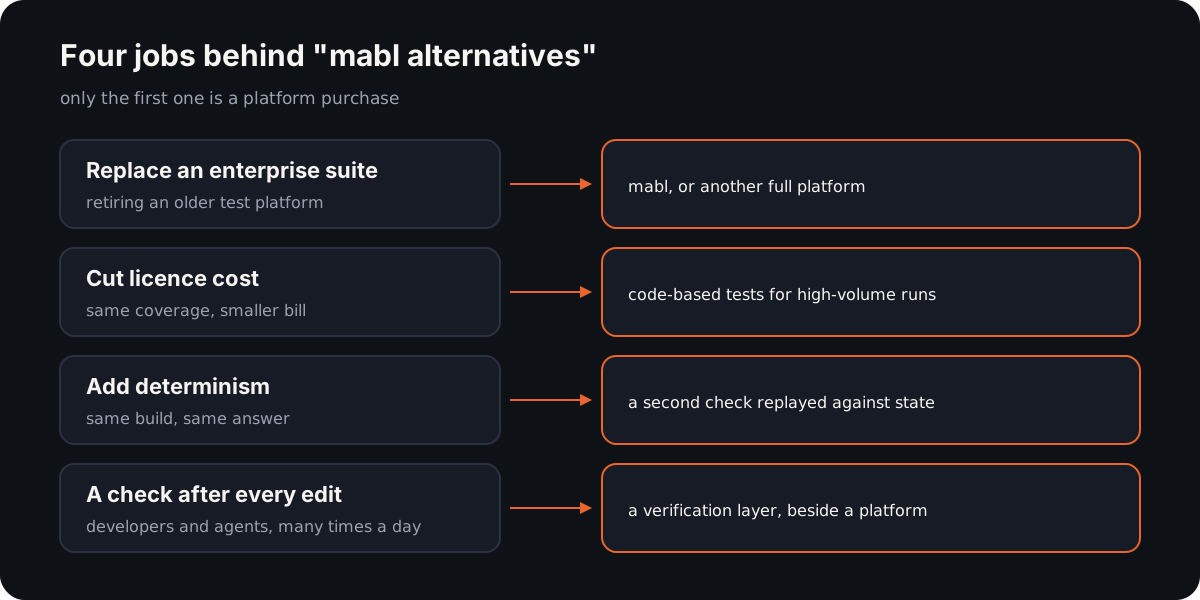
The four jobs behind "mabl alternatives"
1. Replace an enterprise suite. You are retiring an older test platform, or you are choosing between mabl and its peers. The comparison table covers the mabl competitors on one axis: what decides pass or fail.
2. Cut licence cost. You like the workflow and want a smaller bill, or checks as code with no licence at all. See why teams look beyond mabl and the team-shape table.
3. Add determinism to an existing suite. Your suite runs, and you want a second verdict that gives the same answer for the same build. See what each verdict source can conclude.
4. Give developers a check after every edit. Agents and developers change the app many times a day, and a QA-owned platform runs later. See where Reticle fits.
Why teams look beyond mabl
None of these is a weakness in the product. Each is a fit question.
Platform cost at scale. mabl pricing is quote-based: its pricing page shows no dollar figure on 2026-11-02. It says "Request a Quote" and offers "a starting point of 500 credits per month for cloud test runs". It also says "local test runs are free", and mobile testing is listed under add-ons. Price your commit volume before signing.
Migration onto a platform. mabl's Playwright import docs say "Variables, code blocks, if statements, and loops are not migrated during the import session" (docs).
A developer-native check, not a QA-owned platform. Some teams want the check to live with the code. mabl does reach into that space: "Connect the mabl MCP server or CLI, and your agent can test changes in your target environments" (mabl). The difference is where the test lives and who owns it.
An open-source component. Some organisations need part of the test stack to be code they can read and fork. mabl is a commercial platform; Playwright and Midscene.js are MIT-licensed, and Reticle's SDK is open source.
mabl alternatives compared
Each cell comes from the tool's own pages, checked on 2026-11-02. Verdict sources follow our BrowserStack alternatives page.
| Tool | Category | Verdict source | What it catches | What it misses | Price shape | Best fit |
|---|---|---|---|---|---|---|
| mabl | Enterprise test platform | Assertion, DOM; AI judgement on screenshots | Your assertions across web, mobile, API and Salesforce, with per-step evidence | Anything nobody asserted or described | Quote; local runs free | QA organisations that need governance and audit evidence |
| Momentic | AI-native test platform | AI judgement, DOM, pixels, network | Plain-English checks on web and native mobile | Firefox and Safari: web runs on Chromium-family browsers | Free tier, then per credit | Teams that want tests written in plain English |
| Reticle | Verification layer | App state, network, DOM | Silent failures: a double submit, a store that never updated, a console error | Native mobile, cross-browser rendering, pixels | Open-source SDK and free plan; paid platform | Developers whose agents change a web app they own |
| Functionize | AI-native test platform | Unclear | What its agents are told to check | Not publicly documented | Free tier, then monthly plans with credits | Teams that want agents to write and run tests |
| TestMu AI | Device cloud | Assertion, device matrix | Your tests on real phones, tablets and browsers | Anything your assertions do not check | Free tier, then per plan | Teams that need real devices |
| Playwright (self-hosted) | Driver and test runner | Assertion; pixels with screenshots | Your assertions in Chromium, Firefox and WebKit | Anything nobody asserted; native apps | Free, open source | Teams that want checks as code they own |
| Midscene.js | Open-source AI agent | AI judgement | Natural-language checks on web, mobile and desktop | Whatever the model you configure misreads | Free, open source; model costs are yours | Teams that want AI steps they host |
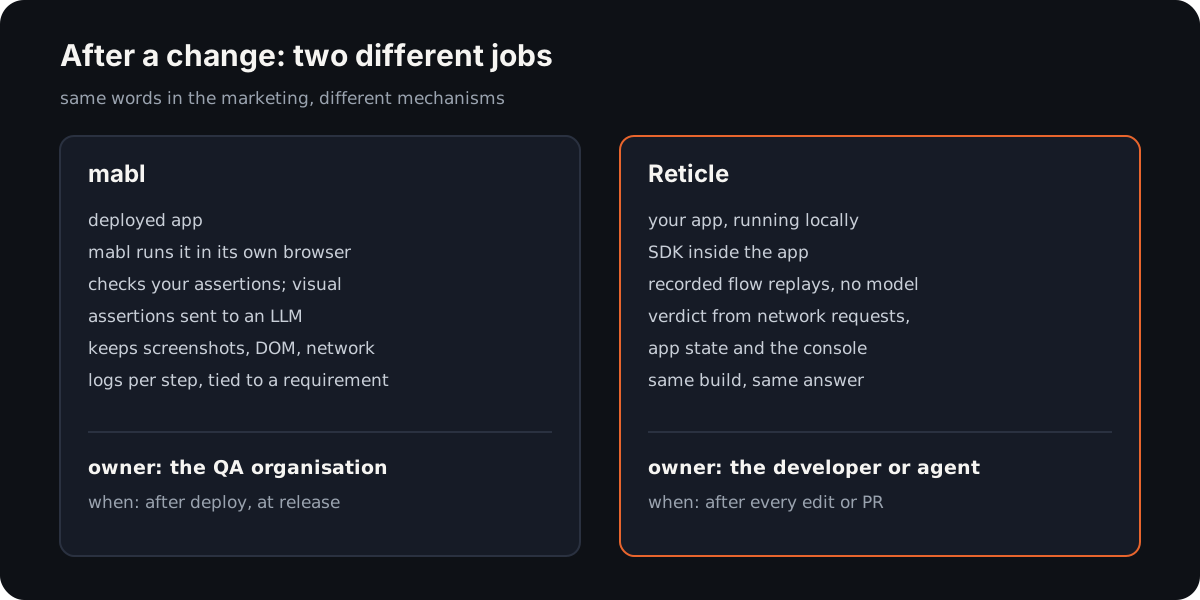
mabl says it "runs your deployed app in a real browser, in a separate context, and checks it against assertions you defined separately" (verify your code). Its visual assertions "evaluate based on the screenshot of the element, not the DOM or the page source" (help). Which model judges them is not stated in the public docs we read.
Functionize says "A machine learning core verifies what your application does" (Functionize), without public detail on how (see Functionize alternatives). Its pricing page lists a $0 plan and Growth at "$20/mo" on 2026-11-02 (pricing). TestMu AI advertises "Real Device Testing on 50,000+ iOS and Android Devices" (TestMu AI).
What each verdict source can conclude
The general breakdown is on the BrowserStack alternatives page, and our Momentic alternatives page covers AI judgement in detail. Two points matter for mabl.
Assertions you defined conclude exactly what someone wrote down. mabl's "separate context" point is a good one: an agent told to make a test pass cannot quietly weaken a check it never sees.
AI judgement on a screenshot is where mabl AI testing goes beyond selectors: it can check text quality and images. mabl reduces drift by generating "assertion criteria" the first time and sending them to the model on each run (help). The answer still comes from a model.
App state concludes that the request, the store and the console hold what the flow should produce. It cannot judge wording, and it gives the same answer for the same build.
Where Reticle fits, and where it does not
Reticle runs inside your web app as an SDK. An agent drives a flow once; saved flows replay with no model and decide from network calls, app state and the console.
Where it fits:
- Bugs a green run hides. On an 88-bug registry it caught 86, against 60 for a Playwright script driving the same flows (measured 2026-07-24, confidence table).
- A cheap check after every edit. A four-flow suite re-verifies in 483 tokens with 0% flake over eight replays (scorecard).
Where it does not. Reticle does not replace an enterprise test platform:
- Enterprise governance. mabl lists "SOC 2 Type II • SSO/SAML • RBAC • SLA-backed support" (platform) and dashboards "across every workspace". Reticle's platform tier offers SSO and an audit trail, but it publishes no SOC 2 report and no governance dashboards.
- Audit-ready reporting. mabl keeps "screenshots, DOM snapshots, network logs, and decision rationales" for every step, "kept permanently, pass or fail", traced to requirements (deliver evidence). Reticle has no requirement traceability.
- Mobile and native apps. mabl tests iOS and Android "without the need for a device lab" (mobile). Reticle covers web and desktop apps.
- Low-code authoring. In mabl, "Admins, QA, and developers contribute" (Salesforce), and tests can come from a Jira ticket. Reticle records what an agent did.
- Packaged apps. mabl handles Salesforce "Shadow DOM and dynamic IDs". Reticle needs an app you build.
- Vendor support with an SLA. mabl publishes "live 24x5 support" (pricing). Reticle publishes no SLA.
An enterprise QA organisation replacing a legacy suite should choose mabl.
Four tools beat Reticle on a stated axis. mabl beats it on governance, audit evidence, native mobile and low-code authoring.
TestMu AI beats it on real devices. Playwright beats it on browser engines and cost per re-run, since a compiled suite costs zero tokens. Momentic beats it on plain-English tests.
Which mabl alternative fits your team
| Team shape | Recommendation |
|---|---|
| Enterprise QA organisation replacing a legacy suite | mabl. Governance, evidence and low-code authoring in one purchase. |
| Regulated team that already runs mabl | Keep mabl. Its per-step evidence is the hard part to rebuild. |
| Small product team, Chromium is enough, tests in plain English | Momentic. Watch credit use as run volume grows. |
| Release needs real phones and tablets | TestMu AI or another device cloud, beside whatever writes the tests. |
| Developers want checks as code, no licence | Playwright self-hosted; Midscene.js for AI steps you host. |
| Agents edit a web app many times a day, QA owns release | Run both: Reticle on every change, mabl at release. |
Running both looks like this in a pipeline. Each pull request runs Reticle's recorded flows against the preview build, with no model call, and fails the check on a broken request or state change. After merge, the staging deploy runs the mabl suite, which owns cross-browser, mobile and Salesforce coverage and keeps the evidence for the release record.
Buying for a QA team? Our AI QA tools guide lists eleven vendor questions.
Migration effort
From mabl to Playwright. mabl tests export writes Playwright TypeScript or Selenium IDE files (export docs). Select, drag-and-drop, JavaScript snippets, API steps and cookies do not export to either format, so those steps are rewritten by hand. The export page does not mention run history or stored evidence, so plan as if they stay in mabl.
From Playwright to mabl. Recorded steps import; logic does not. Loops, conditions and variables are rebuilt in mabl, and "mabl tests do not support Playwright's array assertions or assertions using regular expressions" (import docs).
Our estimate for either direction, for an engineer who knows both tools: half a day per ten tests, plus time for each unsupported step. Adding Reticle beside mabl. Nothing moves. RETICLE_INSTALL_SOURCE=blog npx @reticlehq/server init installs the SDK, and an agent records each web flow by driving it once. Our estimate: half a day to install, then under an hour per flow.
These are estimates from the steps involved, not measurements.
Fun fact
"Deliver evidence" would have confused the first auditors, who mostly listened. The word comes from the Latin audire, "to hear". In medieval Britain, auditors had the accounts read out to them and checked for negligence or fraud (Wikipedia, Wiktionary). An audit trail was once something you heard.
Conclusion
The mabl alternatives that matter depend on which purchase you are making. For governance, audit evidence, mobile and low-code authoring across a QA organisation, mabl is the right platform. For checks as code with no licence, Playwright. For a cheap, repeatable verdict after every edit to a web app, add a verification layer, and keep mabl where it already does the job.
FAQ
What are the best mabl alternatives?
The best mabl alternatives depend on the job. For another full platform, Momentic or Functionize; for real devices, TestMu AI; for checks as code, self-hosted Playwright; for open-source AI steps, Midscene.js. For a repeatable check after every edit, add a verification layer such as Reticle. An enterprise QA organisation should usually stay on mabl.
How much does mabl cost?
mabl does not publish a price; its pricing page says "Request a Quote" as of 2026-11-02. Plans start from 500 credits per month for cloud test runs, local test runs are free, and mobile testing is an add-on. A 14-day free trial is available, so you can measure your own run volume first.
mabl vs Playwright: which should I use?
In mabl vs Playwright, mabl suits QA teams that want low-code authoring, mobile, Salesforce and audit evidence in one managed platform. Playwright suits developers who want tests as code, three browser engines and no licence. mabl can export tests to Playwright, though some steps, such as JavaScript snippets, must be rewritten by hand.
Can you use mabl and Reticle together?
Yes, you can use mabl and Reticle together. Reticle runs on each pull request and checks what a change did to requests, state and the console, with no model call. mabl runs after deploy for cross-browser, mobile and Salesforce coverage, and keeps the evidence for the release. Neither tool needs to change for the other.