
On this page
If you are comparing Functionize alternatives, you are probably making one of two different purchases. One is an enterprise QA leader replacing a large, outsourced testing operation, who needs scale, governance, services and a procurement story. The other is a team shipping agent-written code, who needs a cheap, repeatable answer after every edit. Functionize is built for the first.
If you are the second, you can Start a 14-day trial (sign in, then add a card under Billing; the free plan needs none) or read the open-source SDK first.
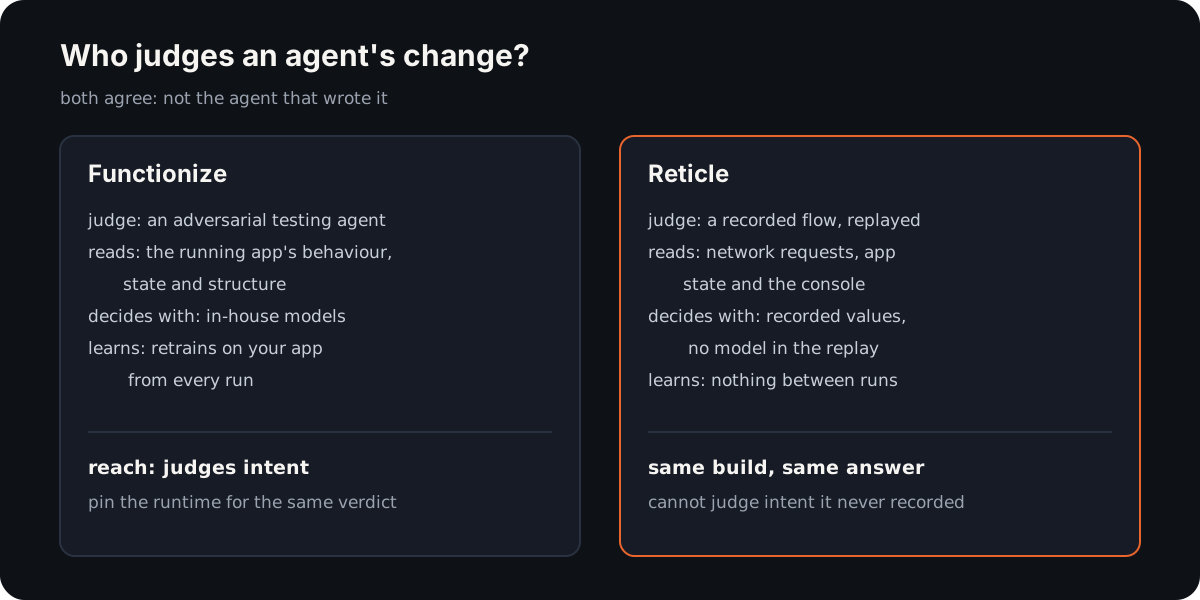
Both sit in the AI QA category, and both start from the same premise: the agent that wrote a change should not be the one that judges it. Functionize says "No agent can prove the quality of its own output" (enterprise). Where they part is who judges instead. That is a disagreement about mechanism, not a missing feature, and this page treats it as one.
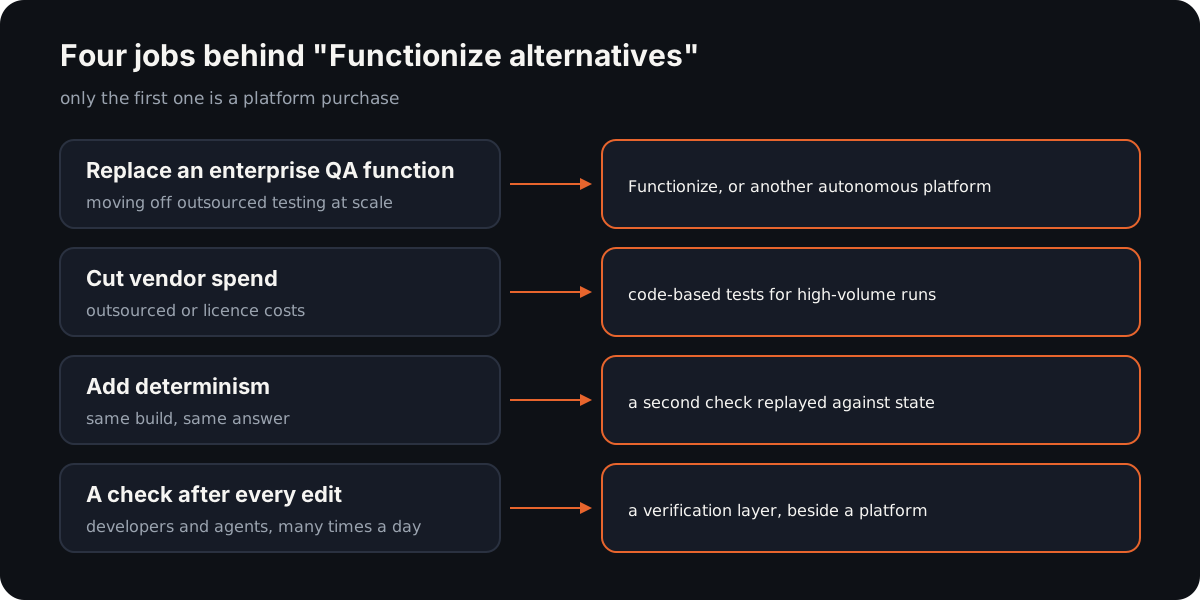
The four jobs behind "Functionize alternatives"
1. Replace an enterprise QA function. You are moving off outsourced or manual testing at scale and comparing autonomous testing platforms. The comparison table covers them.
2. Cut vendor or outsourced spend. You want the same coverage for less, or checks as code with no licence. See why teams look beyond Functionize and the team-shape table.
3. Add determinism to an existing suite. You want a second verdict that gives the same answer for the same build. See what each verdict source can conclude.
4. Give developers a check after every edit. Agents change the app many times a day, and a platform run happens later. See where Reticle fits.
Why teams look beyond Functionize
None of these says the product is weak. Each is a question of fit.
Enterprise pricing and rollout. Functionize pricing is public up to a point. On 2026-11-02 its pricing page listed a free plan, Growth at "$20/mo" and Scale at "$100/mo", with a per-task credit cost that "changes with the task". Enterprise is "Custom credits per month" with a "12-month minimum", and its price is not public.
The services page describes a guided rollout with a "45-day review" and "A 6–12 month plan" (services).
A platform that assumes QA owns testing. Studio is "a separate, independent testing agent" (launch post) that a quality team points at the application. Some teams want the check to live with the code instead.
An agent's judgement versus a recorded verdict. Functionize says "Agents interpret what you mean. A machine learning core verifies what your application does" (Functionize). It also says "Pin the runtime and the model behaves identically across runs: same element matching, same verdict", and that "The model retrains on your app from every run" (architecture).
How a pass is computed from what the model sees is not publicly documented.
An open-source component. Some organisations need part of the stack to be code they can read. Functionize is a commercial platform.
Functionize alternatives compared
Each cell comes from the tool's own pages, checked on 2026-11-02.
| Tool | Category | Verdict source | What it catches | What it misses | Price shape | Best fit |
|---|---|---|---|---|---|---|
| Functionize | Autonomous testing platform | AI judgement (in-house models); how a pass is computed: unclear | Web flows, packaged apps, API, database and visual checks | Not publicly documented | Free tier, then monthly plans; Enterprise not public | Enterprises replacing a large QA operation |
| mabl | Enterprise test platform | Assertion, DOM; AI judgement on screenshots | Your assertions across web, mobile, API and Salesforce | Anything nobody asserted or described | Quote; local runs free | QA organisations that need audit evidence |
| Reticle | Verification layer | App state, network, DOM | Silent failures: a double submit, a store that never updated, a console error | Native mobile, packaged apps, pixels | Open-source SDK and free plan; paid platform | Developers whose agents change a web app they own |
| Momentic | AI-native test platform | AI judgement, DOM, pixels, network | Plain-English checks on web and native mobile | Firefox and Safari: web runs on Chromium-family browsers | Free tier, then per credit | Teams that want tests in plain English |
| TestMu AI | Device cloud | Assertion, device matrix | Your tests on real phones, tablets and browsers | Anything your assertions do not check | Free tier, then per plan | Teams that need real devices |
| Playwright (self-hosted) | Driver and test runner | Assertion; pixels with screenshots | Your assertions in Chromium, Firefox and WebKit | Anything nobody asserted; native apps | Free, open source | Teams that want checks as code they own |
| Midscene.js | Open-source AI agent | AI judgement | Natural-language checks on web, mobile and desktop | Whatever the model you configure misreads | Free, open source; model costs are yours | Teams that want AI steps they host |
Functionize "natively supports Salesforce, SAP, Oracle Cloud, Workday, and ServiceNow" and covers "API testing (REST, SOAP, GraphQL, WebSockets), database validation, file handling, and visual diffs" (FAQ). Native app testing in Studio is not clear from its public pages, so the table does not credit it.
On analysts, Functionize says it "was recognized as a Strong Performer in The Forrester Wave™: Autonomous Testing Platforms, Q4 2025" (Functionize blog). That is their claim, on their page; we have not read the report.
What each verdict source can conclude
The general breakdown is on our BrowserStack alternatives page. Two sources matter here.
AI judgement from an independent agent concludes that a model, watching the application run, found it behaved as intended. Its strength is reach: it can judge intent nobody wrote a selector for.
Functionize pins the runtime for repeatability and retrains the model on your app, so the judge improves over time. The verdict still comes from a model.
App state concludes that the request, the store and the console hold the values a recorded flow produced last time. It cannot judge intent it never recorded. Nothing learns between runs, so the same build gives the same answer.
Both sides reject self-grading. The choice is whether the judge should be another model or recorded program state.
Where Reticle fits, and where it does not
Reticle runs inside your web app as an SDK. An agent drives a flow once; saved flows replay with no model and decide from network calls, app state and the console.
Where it fits:
- Bugs a green run hides. On an 88-bug registry it caught 86, against 60 for a Playwright script driving the same flows (measured 2026-07-24, confidence table).
- A cheap check after every edit. A four-flow suite re-verifies in 483 tokens with 0% flake over eight replays (scorecard).
Where it does not. Reticle is not an enterprise QA platform:
- Enterprise scale. Functionize runs each test "in its own clean environment" and offers private deployment and data residency (enterprise). Reticle runs in your own dev and CI environments.
- Governance and compliance programmes. Functionize publishes "SOC 2 Type II" with the report on request. Reticle's platform tier offers SSO and an audit trail, but publishes no SOC 2 report.
- Packaged-app testing. Salesforce, SAP, Oracle Cloud, Workday and ServiceNow are covered by Functionize. Reticle needs an app you build.
- Services-led rollouts. Functionize sells customer success, technical account managers and professional services. Reticle sells none.
- Analyst procurement requirements. If your process requires a vendor in an analyst evaluation, Functionize publicises one. Reticle does not have one.
- A mandatory vendor SLA. Reticle publishes none. Functionize publishes response-time goals, though its page says missing them "will not constitute a breach" (support), so ask about a contractual SLA.
An enterprise replacing an outsourced QA function should evaluate Functionize.
Four tools beat Reticle on a stated axis. Functionize beats it on packaged apps, authoring and maintaining tests from a description, and enterprise services. mabl beats it on native mobile and audit evidence. TestMu AI beats it on real devices.
Playwright beats it on browser engines and cost per re-run, since a compiled suite costs zero tokens.
Which Functionize alternative fits your team
| Team shape | Recommendation |
|---|---|
| Enterprise replacing an outsourced QA function | Functionize. Scale, packaged apps and a services-led rollout in one purchase. |
| Regulated QA organisation that needs per-step audit evidence | mabl. It keeps evidence for every step, traced to requirements. |
| Small team, Chromium is enough, tests in plain English | Momentic. Watch credit use as volume grows. |
| Release needs real phones and tablets | TestMu AI or another device cloud, beside whatever writes the tests. |
| Developers want checks as code, no licence | Playwright self-hosted; Midscene.js for AI steps you host. |
| Agents edit a web app daily, QA owns the release | Run both: Reticle on every pull request, Functionize on the release candidate. |
In the "run both" pipeline, each pull request replays Reticle's recorded flows against the preview build and fails on a broken request or state change. The release candidate then goes to Functionize for packaged-app, API and cross-browser coverage. Our mabl alternatives and Momentic alternatives pages cover the other two platforms in depth.
Migration effort
Onto Functionize from a code suite. Its FAQ says "Existing suites from Selenium, Appium, Playwright, and Cypress can be imported and executed" (FAQ).
For an enterprise, the published rollout has phases rather than a number: a kickoff and onboarding in the first 30 days, a "45-day review" in days 31 to 60, optimisation through day 90, then "A 6–12 month plan" (services). That is their success plan, not a deployment estimate, and we do not estimate one.
Off Functionize. Its FAQ says reports export "as CSV, PDF, or shared via read-only links". We found no public documentation of exporting tests as code, so plan to rebuild flows in the new tool, and ask the vendor before you sign.
Adding Reticle beside Functionize. Nothing moves. RETICLE_INSTALL_SOURCE=blog npx @reticlehq/server init installs the SDK, and an agent records each web flow by driving it once. Our estimate: half a day to install, then under an hour per flow, from the steps involved rather than a measurement.
Fun fact
The word "robot" comes from Karel Čapek's 1920 play R.U.R., but Čapek said his brother Josef invented it (Wikipedia). Its root means "servitude" (Wikipedia). A century later, the robots are testing each other's work, which is either progress or a union issue.
Conclusion
The Functionize alternatives worth your time depend on which purchase you are making. For enterprise autonomous testing, with packaged apps and a services-led rollout, Functionize is a strong candidate. For checks as code, Playwright. For a cheap, repeatable verdict after every agent edit to a web app, add a verification layer, and keep the platform where it does the job.
FAQ
What are the best Functionize alternatives?
The best Functionize alternatives depend on the job. For another enterprise platform, mabl; for plain-English tests, Momentic; for real devices, TestMu AI; for checks as code, self-hosted Playwright; for open-source AI steps, Midscene.js. For a repeatable check after every agent edit, add a verification layer such as Reticle.
How much does Functionize cost?
Functionize publishes self-serve prices: on 2026-11-02 its pricing page listed a free plan, Growth at $20 a month and Scale at $100 a month, each with monthly credits. Enterprise pricing is not public; it is custom, with a 12-month minimum. How many credits a task uses varies by task.
Functionize vs mabl: which should I choose?
In Functionize vs mabl, Functionize suits enterprises that want an autonomous agent to write and judge tests, plus SAP, Oracle, Workday and ServiceNow coverage and a services-led rollout. mabl suits QA teams that want low-code authoring, native mobile and per-step audit evidence. Both publish SOC 2 Type II and SSO.
Is autonomous testing reliable?
Autonomous testing is as reliable as the judge behind it, so ask how a pass is decided. Functionize says pinning the runtime gives the same verdict across runs. A recorded check against program state is repeatable by construction but cannot judge intent. Pilot any autonomous testing platform on your own flows before committing.