On this page
Most lists of AI testing tools rank them by features, integrations and a score out of ten. This one compares twelve on a single column those lists leave out: what each tool uses to decide pass or fail. That column tells you what a green run can prove.
How to read this list
Method. Every cell comes from the tool's own documentation, pricing or product page, read on 28 October 2026 and linked in each entry. Where a page does not say how the verdict is made, the cell says "unclear". Where a price is not published, it says "not public".
Inclusion. A tool is in if it uses AI somewhere in testing and its mechanism is publicly documented. We cut five candidates, listed in the update log.
Testing. We did not run all twelve. This is a documentation comparison, except for Reticle, whose numbers come from its published benchmark.
For the category itself, see our AI QA guide.
If program-state verification is what you need, Start a 14-day trial or read the open-source SDK first.
AI testing tools: the comparison table
| Tool | Category | Verdict source | What it catches | What it misses | Price shape | Best fit |
|---|---|---|---|---|---|---|
| Applitools Eyes | Visual regression | Pixels plus DOM structure | Layout and visual changes across browsers and viewports | Logic and data errors that render the same | Per checkpoint, unlimited users | Design-heavy apps on many browsers |
| Chromatic | Visual regression | Pixels: snapshots compared over time | Visual, interaction and accessibility issues in components | Behaviour outside your stories and tests | Free tier, then per snapshot | Teams already on Storybook |
| Diffblue | AI test generation (unit) | Assertions in generated Java unit tests | Regressions in Java methods and classes | The UI, and code it cannot cover | Per line of coverage added | Large Java codebases with low coverage |
| mabl | AI test generation | Assertions plus automatic checks; visual judgement unclear | JavaScript errors, broken links, visual changes, slowdowns | Unclear from public pages | Quote; credits for cloud runs | QA teams covering web, mobile and API |
| Meticulous | Record-and-replay | Pixels: a snapshot after each event, against the base commit | Visual and behavioural changes in recorded sessions | Real backend behaviour, mocked by default | Not public | Frontend teams with real user traffic |
| Midscene.js | Open source with AI | Model reads a screenshot (aiAssert) | What a user would see, including canvas and native apps | Anything off screen; verdicts depend on the model | Open source (MIT) | Visual checks on hard-to-select UIs |
| Momentic | AI test generation | Plain-English assertions over text, visuals and DOM | User-visible outcomes you describe | Whatever the assertions do not state | Usage credits, no seats; free tier | Teams writing tests in plain English |
| Playwright Test Agents | Open source with AI | Assertions in generated Playwright tests | What the generated tests assert | Anything not asserted; healed tests need review | Open source (Apache-2.0) | Teams already on Playwright |
| QA Wolf | AI test generation, managed | Assertions in Playwright and Appium code | Flows on web, iOS, Android and desktop | Whatever the suite does not assert | Per test run | Teams that want testing done for them |
| Replay QA | Program state, agentic | Agent-written tests; failures read from a runtime recording | Runtime, UI, accessibility, performance and security bugs | Unclear: depends on what its agents explore | Credits; free tier | Teams that want exploration plus root cause |
| Reticle | Program state | App state, network, console and DOM | Silent failures: double submits, unsaved state, console errors | Pixels, cross-browser rendering, native mobile | Open-source SDK and free plan; paid platform | Coding agents changing a web app you own |
| testRigor | AI test generation | Plain-English assertions on page text, OCR or AI | User-visible behaviour described in English | Whatever the English steps do not check | Not public | QA teams without dedicated coders |
Where Reticle loses, by the table. Applitools Eyes and Chromatic beat it on visual regressions: Reticle does not compare pixels or browsers. QA Wolf beats it on native mobile and desktop coverage, which Reticle does not test. Diffblue beats it on unit-test coverage for Java, which Reticle does not generate.
Three architectures: pixel, DOM and program state
Under the product names, every tool here reads one of three things to reach a verdict. The architecture decides what a pass can mean.
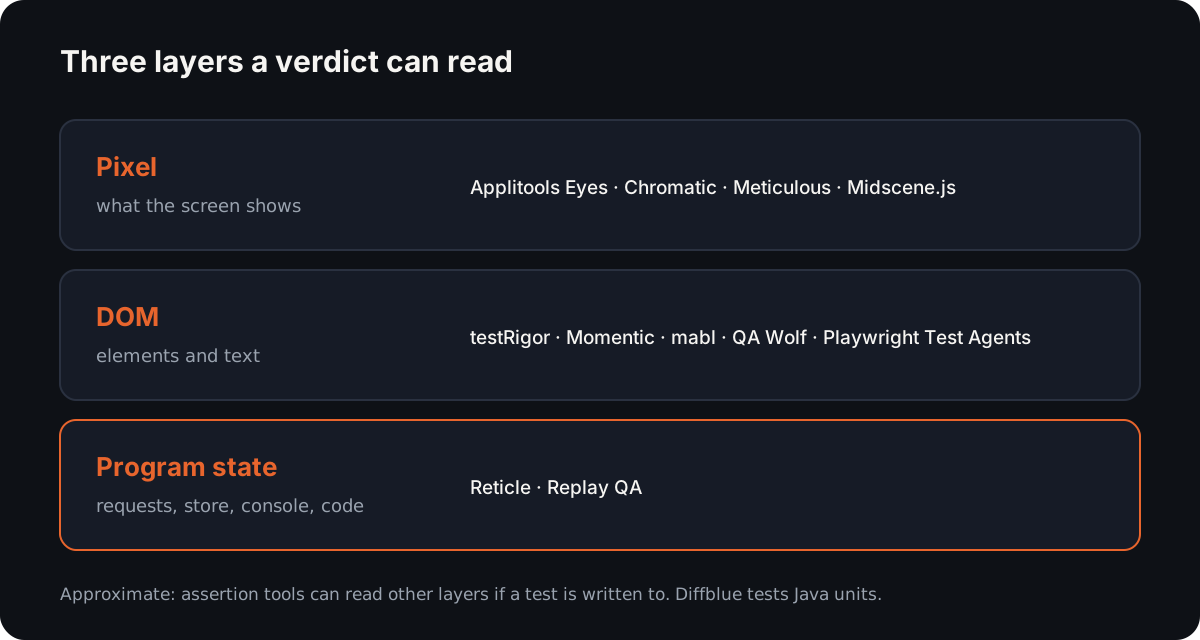
Pixel. The tool compares screenshots, or asks a vision model about one. It sees layout, colour, fonts and anything drawn on a canvas. It cannot see a request that fired twice, a value that was never saved, or an error logged and swallowed, because none of those change the picture. Applitools, Chromatic, Meticulous and Midscene.js sit mostly here.
DOM. The tool checks elements and text: this button exists, that message says "Saved". It is the classic assertion model, and most AI test generation produces it. It sees structure and copy. It misses what never reaches the page: a 500 behind an optimistic update, or a store that changed and changed back.
Program state. The tool reads what the application did: requests and responses, store values, console output, sometimes the code that ran. It can conclude that the payment request fired once and the cart store emptied. It cannot tell you the page looks broken in Safari. Reticle and Replay QA read here, in different ways.
A pixel check and a state check fail on different bugs, and a mature suite usually has both. Which checks belong in that suite at all is the subject of our field guide to automated testing.
The tools
Applitools Eyes. Eyes combines "computer vision with structural DOM analysis" and renders one captured state "across 100+ browsers and viewports" (Eyes). It catches visual regressions a DOM check cannot, and misses logic errors that render identically. Pricing is per checkpoint with unlimited users (pricing). It fits teams whose bugs are mostly visual and spread across browsers.
Chromatic. Built by the Storybook maintainers, it "captures visual snapshots of real code, styling, and assets" and compares them over time (Chromatic). Pricing starts with a free tier and scales by billed snapshots (pricing). It fits component-driven teams on Storybook.
Diffblue. The Diffblue Testing Agent generates Java unit tests at repository scale, and you are "charged for net new lines of coverage added" (pricing). Its offline product, Diffblue Cover, offers "deterministic, offline Java unit test generation" (Diffblue). It verifies methods, not user flows. It fits Java teams with large untested codebases.
mabl. mabl will "automatically detect Javascript errors, broken links, visual changes, and performance slowdowns" (regression testing). Its public pages do not say how visual changes are judged, so that cell says unclear. Pricing is by quote, with credits "consumed based on your usage of cloud test runs" and a 14-day trial (pricing). It fits QA teams covering web, mobile and API in one place.
Meticulous. A script records real sessions, and replays capture "a visual snapshot after dispatching each event", compared with the base commit (how it works). By default it "mocks out any network requests to your backend", which removes side effects and leaves the backend untested. Pricing is not published. It fits frontend teams with real traffic to record.
Midscene.js. An MIT-licensed framework where you describe steps and checks in natural language, and aiAssert has a vision model "check the visible result" (GitHub). Its verdict is only as reliable as the model reading the screenshot. It fits visual checks on interfaces that are hard to select.
Momentic. Steps and assertions live as plain-English YAML in your repository, and "multi-modal assertions" check "text, visuals, and the DOM" (pricing page). Pricing is "usage-based, billed in credits, with no per-user seats", with a free tier. It covers web, iOS and Android (Momentic). It fits teams that want readable tests a coding agent can also edit.
Playwright Test Agents. Playwright ships three agents: a planner that "explores the app and produces a Markdown test plan", a generator that turns it into tests, and a healer that "automatically repairs failing tests" (docs). The verdict is ordinary Playwright assertions. Playwright is Apache-2.0. A healed test still needs a human to confirm it heals onto the right element.
QA Wolf. Agents and QA engineers build tests as "open source Playwright and Appium" code, covering web, iOS, Android and Windows (QA Wolf). Pricing is "pay per test run", and each run "is attempted up to 3 times for free to catch flakes" (pricing). The verdict is the suite's assertions. It fits teams that want coverage delivered rather than built.
Replay QA. Agents explore each build and run tests in Replay's browser while recording. For failures, they "time-travel through the recordings" and "can see the state of the page, the network calls, and the code that ran" (how it works). Pricing is credit-based with a free tier (pricing). It fits teams that want bugs found and explained, not a suite to own.
Reticle. An SDK in your build records each step's requests, store values and console output. A coding agent drives a flow once, and saved flows replay with no model in the loop, which is how re-checking four flows costs about 480 tokens in our published benchmark. It does not compare pixels or test native mobile. It fits teams whose coding agents change a web app they own.
testRigor. Tests are plain English, such as check that page contains "Welcome, Peter!", with options to read the screen "using OCR" or "using AI" (language docs). compare screen to previous version adds a pixel check. Its pricing page returned a 404 when we checked, so the price cell says not public. It fits QA teams without dedicated automation engineers.
For browser runners without AI, see our Playwright alternatives page, and for the frameworks underneath most of these tools, test automation frameworks. For a deeper comparison of nine tools on verdict source alone, see regression testing tools.
Which architecture fits agent-written code
A coding agent changes code faster than anyone reads it, and it reports success in confident prose. Testing agent-written code is mostly about catching the change that looks right and does something else.
That failure is usually invisible to pixels. The button renders, the toast says "Saved", and the request behind it returned a 500, or fired twice. A pixel tool passes it. A DOM check passes it if the toast is what it asserts.
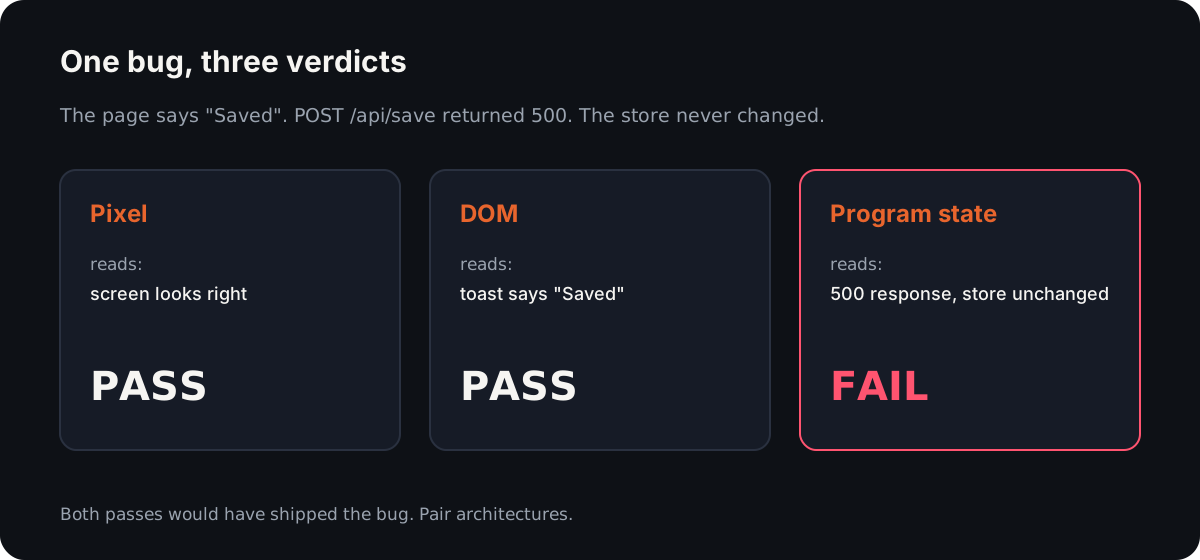
Program state catches it, because the evidence is in the request log and the store, not on the screen. That is the job generative AI tools for software testing tend to skip: generating a test is cheap now, and deciding what the app actually did is where it goes wrong.
So pair them. Use a program-state check for the flows an agent touches, and keep a visual tool if your bugs are visual.
Open source
If you searched for AI testing tools open-source, three projects here qualify, and each leaves something out.
| Project | Licence | What it includes | What it does not include |
|---|---|---|---|
| Playwright with Test Agents | Apache-2.0 | Runner, assertions, codegen, planner, generator and healer agents | The model: you bring your own AI tool to drive the agents |
| Midscene.js | MIT | Natural-language actions and aiAssert, Playwright integration, reports | The model and its cost: you configure and pay for one |
| Reticle SDK | Apache-2.0 | In-app recording, verdicts, flow replay, MCP server | Shared run history, team features and the hosted Harness, which are the paid platform |
Two popular MIT projects, Stagehand and Browser Use, are browser automation SDKs. They drive pages well, but they have no pass or fail of their own, so they are not on this list. Qodo Cover (AGPL-3.0) generated unit tests, but its repository says it "is no longer maintained".
Open source covers the engine. What you usually pay for is the model, the history, and someone else running it.
What we got wrong about our own category
We started where the category started: assuming generation was the bottleneck. Reticle began with an overnight agent run that built the wrong thing and reported success. The first fixes were all on the generation side: a loop, a different model, stricter prompts. Each produced "the same class of failure", as our founding post puts it, because nobody was checking.
That cost us weeks and a lot of tokens, and the next attempt was wrong too: driving a browser with screenshots, which saw the page but not what the app did. Look at the table and you will see the same habit across the field: most tools lead with how they create tests. Fewer document how a verdict is reached, which is why this page needed an "unclear" cell at all.
What changed for us was treating judgement as the product. We built from the inside of the app out, and we publish the benchmark that measures the verdict, losses included.
Update log
28 October 2026. First version. Twelve tools verified from public pages. Cut: Octomind (its domain did not resolve, so nothing could be verified), Stagehand and Browser Use (no pass or fail of their own), Qodo Cover (unmaintained), and Percy (verified, but already compared in our regression testing post; we kept this list to twelve).
We will revise this page every quarter, next by the end of January 2027, re-checking every cell against its source and logging what changed.
Fun fact
Selenium, the tool most AI testing tools are measured against, started in 2004 at ThoughtWorks in Chicago as "JavaScriptTestRunner", built to test an internal time and expenses application (Selenium history). The first browser automation tool most teams used was written to check one expense app.
Conclusion
The best AI tools for software testing differ less in features than in what they read. Pixels see appearance, the DOM sees structure, and program state sees behaviour. Pick by the bugs you actually ship, check every vendor's verdict source against its own documentation, and expect to need more than one.
FAQ
What are the best AI testing tools?
It depends on the bugs you ship. Applitools Eyes and Chromatic suit visual regressions, testRigor and Momentic suit plain-English tests, QA Wolf suits managed coverage, and Diffblue suits Java unit tests. For agent-written web changes, use a program-state tool such as Reticle or Replay QA. Most teams combine two architectures.
Are AI testing tools worth it?
They are worth it when the verdict is repeatable and you can see the evidence behind it. Generating tests is cheap now, so judge a tool on how it decides pass or fail, not how fast it writes tests. Run a two-week pilot on your own flows, with bugs you planted, before committing.
What is the best free AI testing tool?
Playwright with its Test Agents is free and Apache-2.0, though you supply the model. Midscene.js is MIT and also needs a model you pay for. Several commercial tools have free tiers, including Chromatic, Momentic and Replay QA, and Reticle's SDK is Apache-2.0 with a free plan.
Do AI testing tools replace Selenium?
Some replace the runner, but most still produce or run ordinary browser automation underneath. QA Wolf writes Playwright and Appium code, and Playwright's agents generate Playwright tests. What AI changes is who writes and maintains the tests. A suite still needs assertions that check the right thing.
Which AI testing tool is best for a small team?
Start with what costs nothing to try: Playwright with Test Agents if you already write code, or a free tier from Momentic, Chromatic or Replay QA. If coding agents write much of your code, add a program-state check for the flows they touch. Avoid per-seat pricing that limits who can read results.
Why Reticle
Your agent says it works. Reticle checks.
- Checks each change inside the running app: network, state and console, not a screenshot.
- Returns a pass or fail with the evidence and the file:line to fix.
- Open-source SDK on your machine, or the platform on every preview and PR.
No credit card required.