
On this page
- What is a test automation framework?
- Framework, harness, runner, library
- The five software testing frameworks people actually choose between
- The assertion surface: what each framework can see
- Maintenance cost per 100 tests
- Agent compatibility: can an agent read the failure?
- Selection guide: five team shapes
- Migration notes: what breaks, what transfers
- Fun fact
- Conclusion
- FAQ
Teams pick a test automation framework in an afternoon, on how nice the first test feels. They keep it or abandon it two years later for different reasons: what the framework can assert on, and what the suite costs to keep green. Every comparison of test automation frameworks covers the afternoon. This one covers the two years.
It assumes you know what a test harness is, the scaffold around your tests. The framework is the library you build that scaffold from, and one layer of automated testing as a whole.
What is a test automation framework?
A test automation framework is a reusable library that defines how tests are written, discovered, run and reported: the test syntax, the assertion API, the runner, and the hooks for setup and teardown. It decides what a test is able to observe. Your fixtures, data and checks sit on top of it.
The last sentence is the one that matters in year two. Whether you call it a testing framework or an automated testing framework, it sets the ceiling on what your suite can notice, and no amount of discipline lifts it.
Framework, harness, runner, library
These four words get swapped constantly. Each row owns something different.
| Term | What it is | Example |
|---|---|---|
| Framework | The library tests are written in: syntax, assertions, runner, hooks | Jest, pytest, Playwright Test |
| Harness | Your project's whole scaffold built on a framework: fixtures, drivers, checks, reporting | Jest plus your mocks, factories and helpers. The testing harness guide has the five parts |
| Runner | The part that finds tests, schedules them and sets the exit code | jest, pytest, npx playwright test |
| Library | Code a test calls, with no opinion on how tests are run | Testing Library, node:assert, Selenium WebDriver |
Most of the five below ship as all three of framework, runner and assertion library. That is why switching one feels like switching everything.
The five software testing frameworks people actually choose between
Every claim in this table was checked against each project's current documentation, linked in the first column.
| Framework | Primary use | Language | Assertion surface | Parallelism model | Best fit |
|---|---|---|---|---|---|
| Jest | Unit and integration tests for JavaScript | JavaScript, TypeScript | Return values, mocks, snapshots, and a simulated DOM through jsdom. The default environment is Node | A pool of worker processes, by default one per core minus one. Tests in a file run in order unless marked test.concurrent | Existing Node or React codebases with a large Jest suite |
| Vitest | Unit and component tests on Vite | JavaScript, TypeScript | The same as Jest in Node or jsdom, plus a real browser in browser mode through a Playwright or WebdriverIO provider | Test files run in parallel across workers. The default pool is forks, one child process per file | Vite projects, and teams who want component tests in a real browser without a second framework |
| pytest | Unit, integration and API tests for Python | Python | Plain assert with introspection on failure, captured stdout and stderr, anything importable in the process | Serial by default. Parallel through the pytest-xdist plugin, pytest -n auto | Python services, data pipelines, and browser tests through the Playwright plugin |
| Playwright Test | End-to-end tests in real browsers | TypeScript, JavaScript. The library also has Python, Java and .NET bindings | Real rendered pages, the DOM through locators with auto-retrying assertions, and network through routing and response waits | Worker processes. Files run in parallel by default, tests in a file in order unless fullyParallel is set | Cross-browser flows, multi-tab and multi-origin journeys |
| Cypress | End-to-end and component tests | JavaScript, TypeScript | The DOM, network through cy.intercept, and the app's own window through cy.window, because commands run inside the browser | Specs run one after another on a machine. Spreading them across machines uses recorded runs in Cypress Cloud | Single-origin web apps, and front-end teams who debug by watching the app run |
Two limits worth knowing before you commit. Cypress drives one browser at a time and binds each test to one superdomain, with cy.origin for cross-origin steps. Its WebKit support is experimental.
pytest has no parallelism of its own and needs the xdist plugin. For browser runners beyond these two, Playwright alternatives compares four of them on what they verify.
The assertion surface: what each framework can see
Developer experience decides the first test. The assertion surface decides which bugs the hundredth test can catch. There are five places a bug can show up, and no framework reaches all five natively.
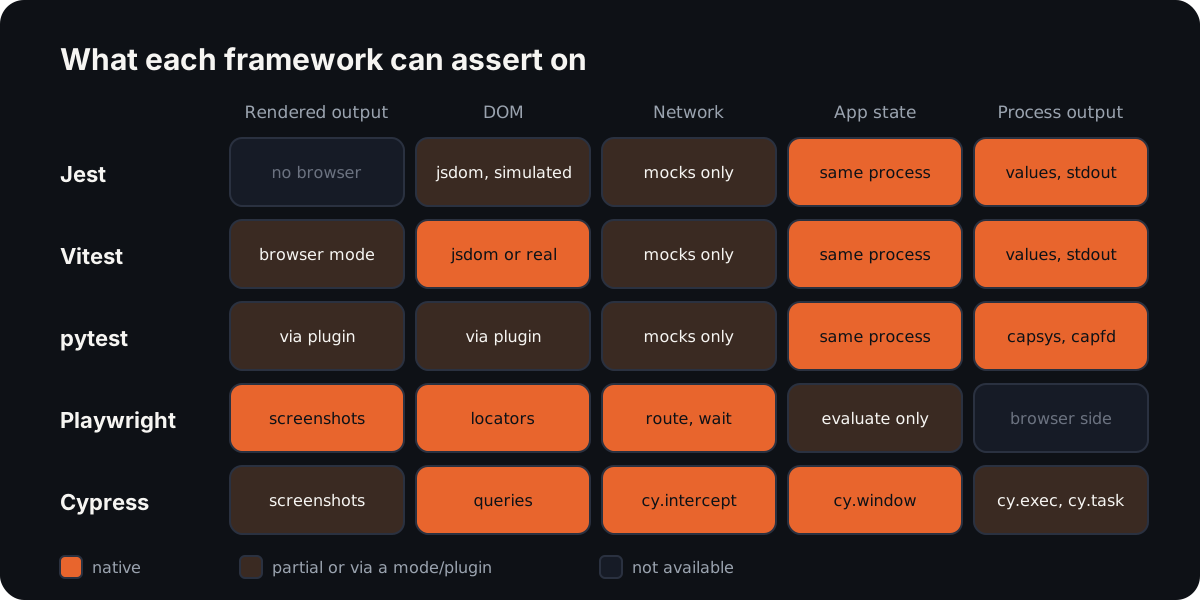
Rendered output and the DOM. Playwright and Cypress assert against a real browser. Jest sees jsdom, a simulation with no layout, so "the button is visible" means "the element exists and is not hidden by a style". Vitest closes most of that gap in browser mode. pytest reaches a browser only through a plugin.
The network. Unit frameworks see the requests you mocked, which means they see your assumptions about the API, not the API. Playwright and Cypress can observe real traffic: wait for a response, read its status, inspect the body. That is the difference between "the code called fetch" and "the server answered 200 with the right total".
Application state. The unit frameworks win here: the test runs in the same process as the code, so any variable, store or object is one import away. Browser frameworks see state only through the page. Cypress can reach window directly because it runs inside the browser. Playwright crosses the boundary with page.evaluate, which works, but only for state the app exposes globally.
Process output. Return values, stdout, exit codes and logs belong to the unit frameworks. pytest's capsys and capfd fixtures make captured output a first-class assertion. A browser test sees none of the server's logs unless something ships them to the page.
That line explains why teams climb towards the browser. The grid explains the price: the closer a test gets to the user, the further it gets from the state and logs that say why something broke.
Maintenance cost per 100 tests
This is an estimate from a model, not a measurement. We have no cross-team dataset of maintenance hours, and neither does anyone publishing a single number. Here is the model, so you can put in your own inputs.
Monthly cost per 100 tests = (tests broken by intended changes + flaky failures needing triage) x minutes to diagnose and fix each.
| Input | Unit level (Jest, Vitest, pytest) | Browser level (Playwright, Cypress) | Where the input comes from |
|---|---|---|---|
| Tests broken by intended changes, per month | 2 to 6 | 5 to 15 | Our assumption: browser tests touch more of the product per test |
| Distinct flaky tests to triage, per month | 0 to 2 | 2 to 8 | Our assumption, set against Google's report that about 1.5% of all its test runs were flaky |
| Minutes per fix | 10 to 20 | 20 to 40 | Our assumption |
| Estimated cost | about 0.5 to 2.5 hours a month | about 2.5 to 15 hours a month | The product of the rows |
Treat the range as a shape, not a quote. Browser suites cost several times more per test to keep green, and the gap comes from breakage and diagnosis time, not from the framework's syntax.
What moves the number:
- Selectors. Role and label locators survive redesigns that CSS paths do not.
- Waits. Auto-retrying assertions in Playwright and Cypress remove most timing flakes. A hand-written sleep puts them back.
- Shared state. Tests that reuse one account or one database row fail in an order-dependent way, at the worst time.
- Failure readability. The minutes-per-fix row is mostly reading time. A failure that names the cause takes ten minutes; one that says "timed out" takes forty.
- Who wrote the test. An agent-written test often asserts what the code did rather than what the requirement said, and gets rewritten when the code changes.
Agent compatibility: can an agent read the failure?
When a coding agent fixes a red build, the failure report is its whole view of the problem. For an agent to act on it, the report has to carry five things as text: which test failed and where, the expected and received values, the step in the flow that failed, the effects at that moment (requests, console, state), and whether it reproduces.
Unit frameworks do well on the first two. Jest has --json, pytest has --junit-xml and assertion introspection, and the diff usually points straight at the bug. Browser frameworks are where the cause goes missing.
We ran one real failure on Playwright 1.64.1 to see. The page posts an order, the server answers 500, and the click handler catches the error and logs it to the console. The test expects a confirmation:
Error: expect(locator).toHaveText(expected) failed

Locator: getByRole('status')
Expected pattern: /Order placed/
Received string:  ""
Timeout: 5000ms

Call log:
  - Expect "toHaveText" getByRole('status') with timeout 5000ms
  - waiting for getByRole('status')
    14 × locator resolved to <p role="status"></p>
       - unexpected value ""
Playwright now also writes an error-context.md beside each failure, with instructions addressed to a model, a page snapshot and the test source. That is a real step towards agents. It still did not contain the 500 or the console error, and neither did the JSON report. Both were in the trace zip, which is recorded only when tracing is on.
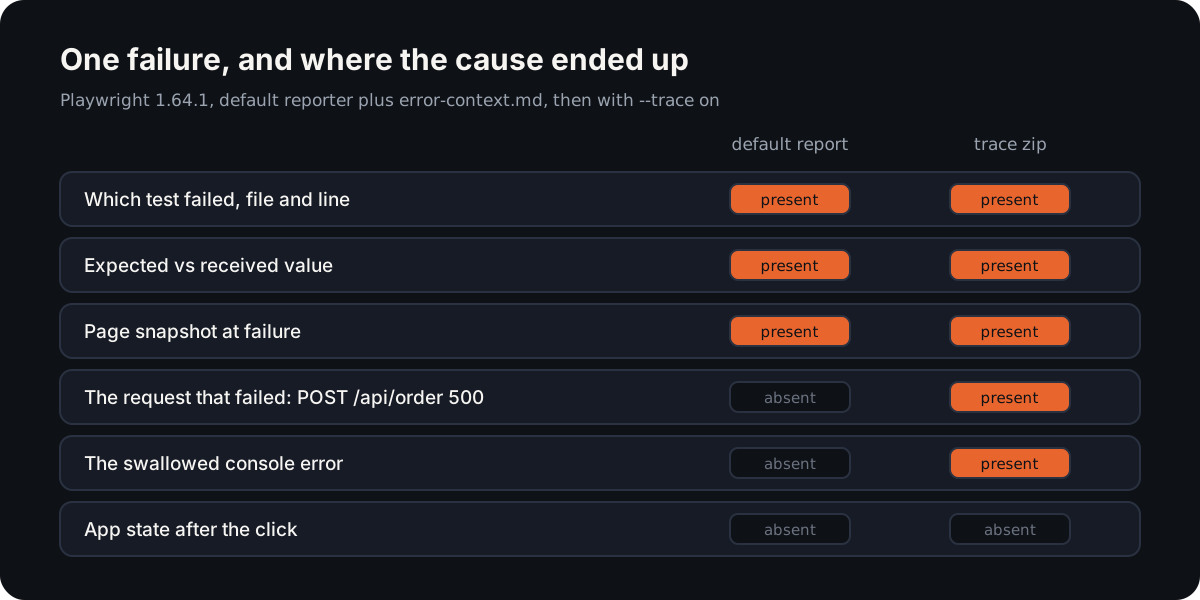
So the agent reads "the text was empty", and the likely next move is to raise the timeout or loosen the assertion. The fix belongs in the API.
That gap is what Reticle fills, and it is not a framework or a runner. Its SDK runs inside the app in development and records network, state and console, so a failed check reports the request that returned 500 next to the empty text. Keep the framework you have; this sits beside it.
Selection guide: five team shapes
- A React or Vue app on Vite, starting fresh: Vitest, with browser mode for components. One framework instead of two.
- A Node codebase with 3,000 Jest tests: stay on Jest. The migration cost buys speed, not new assertions.
- A Python API or data service: pytest, with pytest-playwright if it has a UI.
- A product whose users cross origins, tabs or browsers, like payments or SSO: Playwright.
- A single-origin app built by front-end engineers who debug visually: Cypress. The in-browser runner and direct
windowaccess suit that team better than the default.
Migration notes: what breaks, what transfers
- Jest to Vitest. Most tests transfer. Per the migration guide, globals are off by default,
__mocks__folders load only aftervi.mock(), andmockResetrestores the original implementation instead of emptying it. - unittest to pytest. pytest runs unittest suites as they are, so you can move one file at a time.
- Cypress to Playwright. Chained commands become
awaitcalls, andcy.interceptbecomespage.route. What breaks is timing: implicit retries differ, so expect a round of flakes. - Any framework to another: the assertions transfer. The fixtures and helpers, which are your harness, get rewritten. If you are rebuilding that layer anyway, the verification harness tutorial shows one with assertions on network, state and console.
Fun fact
pytest's plain assert style is older than pytest. Its history page traces it to mid-2004, when PyPy developers started a tool called utest "offering plain assertions". The name changed several times before it settled.
Conclusion
Choose a test automation framework on its assertion surface first, its maintenance cost second, and how nice the first test feels last. Then check what a failure report hands your agent, because that decides whether the next fix is a real one.
FAQ
What is the best test automation framework?
There is no single best one: for unit tests in JavaScript, Vitest on new Vite projects and Jest on existing ones. For Python, pytest. For end-to-end tests, Playwright when you need several browsers or origins, and Cypress for single-origin apps. Choose by what the framework can assert on, then by maintenance cost.
What is the difference between a test automation framework and a testing framework?
In practice they mean the same thing: a library that defines how tests are written, run and reported. "Test automation framework" is more common in QA and end-to-end contexts, "testing framework" in unit testing. Some QA writing also uses it for a team's conventions, such as data-driven or keyword-driven design.
Which framework works with Playwright?
Playwright ships its own runner, Playwright Test, for TypeScript and JavaScript. In Python the recommended route is the pytest plugin, pytest-playwright. Java teams can use JUnit or TestNG, and .NET has base classes for MSTest, NUnit and xUnit. Vitest browser mode can also use Playwright as its browser provider.
What is an AI testing framework?
The term usually means a test automation framework with AI features added: generating tests from prompts, healing broken selectors, or explaining failures. The underlying runner and assertions are still conventional. It is worth asking what the AI part decides. Generating a test is helpful; deciding whether a test passed should stay deterministic.